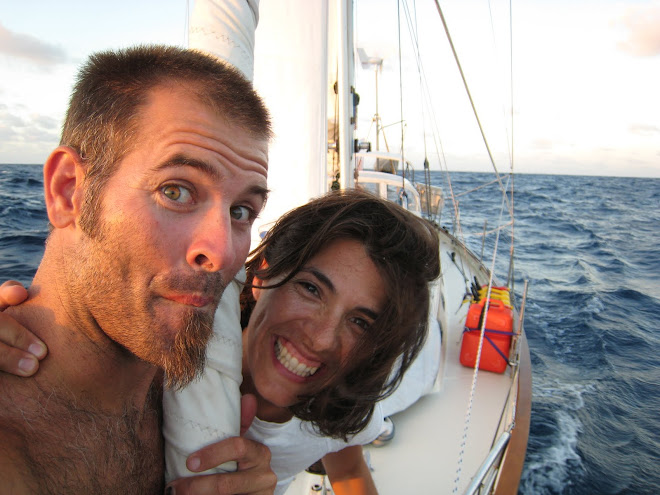
We sailed out of the protected anchorage of Bandaneira and watched the volcano, Gunung Api, slowly slip into the sea. Pulau Run could be seen a few miles away. In the hey-dey of the spice trade, the miniscule island of Run was worth a fortune because of the nutmeg growing on it. In 1667 the British actually traded it to the Dutch for North American's island of Manhattan.
We were officially on passage again, but a short one, only 120 miles to the city of Ambon. A steady SE breeze filled in and the seas were only a few feet, overall it looked like it would be a nice sail. Then our instruments went out. All of them. Fun fun fun. For the next 2 hours I tore everything apart where our electronic "sea talk" connections are located. I pulled and looked at every wire. My head was in the bilge, under the steering column, and in the lazarette. It didn't take long for me to feel seasick. Blah. First day out and in the rolly seas and my heads in the bilge, not where I perform the best. Finally, I pulled a larger connection on the autopilot "brain" and 5 minutes later things are working again. Phew! We crossed our fingers and hoped it wouldn't repeat itself. Thankfully it didn't.
After a pleasant sail through the night with clear starry skies we arrived to the current-swept entrance to Ambon harbor where the huge rain squalls awaited us. It was 7 a.m. and Nicole just finished her watch and went below to sleep. I poured a big cup of coffee, bundled up in full raingear and donned the Ipod in its waterproof case. I piloted DK through the chaotic standing waves while the reggae dub beats synched with my morning coffee buzz. The rainsqualls hammered us incessantly and the small prahu fishing boats zigged and zagged around us dragging for tuna as we surfed the currenty standing waves. Finally we rounded the cape and were met by almost glassy conditions in the lee of the Ambon peninsula. It had been an exciting morning. I looked down below at Nicole; she had slept through it all.
An hour of motoring inside the bay while listening to some new NPR's "This American Life" our friend Marit hooked us up with in Misool (Thank You Marit!!), we dropped our hook in front of a small community called Amahusu. About 7 km SW from the main city of Ambon, Amahusu is nice and mellow and there is a beach and hotel there for easy access to shore. It seemed like a fine anchorage, at least at first.
A few hours later I found myself on the back of an ojek (Indonesian motorbike) heading for the harbormaster's office. Once again, long pants, collared shirt, shoes, shaved face, and my officially looking bag carrying all our paperwork, ship's stamps, and rupiah money (for the, just in case, "greasing the wheels" possibilities).
My first taste of Ambon. Much larger then Sorong, our only other Indonesian city to this point, Ambon was bustling with movement and energy. People were everywhere and traffic was busy. Not being much of a tourist city, once again everyone stared, smiled, and yelled "Hello Mister" as I rode by.
Kota Ambon is the capital of the Maluku islands in Indonesia with a population of almost 400,000 people. Most recently, from 1999-2002, unfortunately Ambon was the epicenter of inter-communal violence between the Christian and Muslim people. In 2001, it is said the city looked similar to the 1980's Beirut, torn apart and battle-scarred. Nowadays, the city is once again bustling with life, economic activity, and the religious tensions have eased.
My first trip to the harbormaster was easy. I chatted it up with some of the young office staff, dropped off my paperwork, and then headed to Quarantine. It was dumping again, but luckily I remembered to bring an umbrella and so I plodded onward in the rain. After a few missed attempts at finding the right office, I was directed correctly to an obscure building on a side street where I clomped in wet and muddy. The office workers were all very friendly and after I was shuffled between 5 different officials, all stamping forms or typing papers, I was finished. No one spoke much English and my Bahasa is still poorly inadequate, but we all stumbled through our conversations and I left smiling and thankful that I only had one more stop to make.
I hailed another ojek, my preferred transportation of choice, as they are so much fun and efficient weaving through the crazy streets and busy traffic. Plus, for 5000 rupiah, or about 50 cents, they will take you anywhere in town right away. If you ride the Bemo's, which are the little mini-van's that shuttle people around, they mostly have set stops and routes and, although cheaper at 3000 rupiah, can take 2-3x as long. Plus they are boring.
We zipped through the streets and up the hill on the other side of town to the Immigration office. As I walked in the front door, I crossed my fingers. This was our last "officialdom" hurdle. The only reason we even came to Ambon was to come to this particular office to renew our passport Visa.
Let me just take a minute to explain what we had to do "to even come" to Indonesia. The following explanation may be a bit boring to some of you, but I think it's interesting to note what we have to deal with to visit some of these countries. It all started month's ago, in January, when we were in Palau--
To sail your boat in Indonesia you need 3 things. First is a boat permit called a CAIT. To do this you need to send in the appropriate paperwork and money to an organization that does this service. We used Bali Marina. This takes between 1-2 months. Next you need a sponsorship letter. We also paid Bali Marina for this. Once you have received these two papers you can apply for your passport social visas. To do this you need to send your paperwork, including your CAIT and sponsorship letter and passports, to an official Indonesian Embassy. We FedEx'ed all our papers to a service in San Francisco who deals with Visa's and delivers the paperwork to the Embassy. Sending your passports overseas is pretty scary, hence the use of an agency in the U.S. and using FedEx. Once all this is finished you are "supposedly" allowed to enter Indonesia (it took us about 3 months).
But that's not all. All of these "Visa's" only last so long. Our CAIT is good for 3 months, and then it needs to be extended again, for a maximum allotment of 6 months. Our passport Visa's are only good for 2 months, then need to be renewed each month. To renew our passport Visa we are supposed to have a new sponsorship letter; someone or some organization who is kind of looking after us.
Talk about ridiculous, but here is where it even gets crazier. In 2004 a new Indonesian law was passed stating that sailing yachts were considered luxury goods and needed to have a "bond" of up to 45% of the yacht value placed in an Indonesian bank for the boat to be in this country. At your first Indonesian port you are supposed to pay this fee and when you leave Indonesia you are supposedly to get this money returned in full. There are many problems with this law. First of all, there is no central banking system that you can use to deposit and withdraw from in different parts of Indonesia. Indonesia is huge! There are over 17,000 islands in this country and so many ports to arrive at and leave from. Let's say, for example, we are checking into Sorong in the West Papua region. We should, by law, have to pay our "bond" of up to 45% of the boat's value. A lot of money for us. Then, 6 months later we check out of another part of the country a thousand plus miles away and need to have our bond money returned, but, wait, the "same" bank is nowhere to be found, and even if it was, Indonesia is not known for it's secure and honest methods of dealing with money. Catch my drift??
But here's the deal. Most ports in Indonesia have not been upholding the "bond" law, until this year. Now it seems like many of the "busy" ports like Kupang, in West Timor, and even Benoa, in Bali, want this money. The reality is no sailing boat is crazy enough to pay it. This is creating quite a stir this year in the sailing community. Because of the complexities of Visa's and the bond law, most sailboats coming to Indonesia do so through a rally. The largest one, Sail Indonesia, which leaves from Darwin, Australia, in the middle of July hosts over 100 boats with another 50 or so on the waiting list. They deal with all the Visa's and also put on a number of cultural performances and parties at different stops along their traveled path through many of the islands in this country.
In our case, coming from Palau and entering into Indonesian waters at Sorong, West Papua, joining a rally wasn't an option, nor would we want to join anyway. To each their own, but we can't imagine being with a group of 100 plus boats sailing to most of the same anchorages. Even if the boats do split up a bit, most of the main anchorages still get very busy. For example, the anchorage at Rinca Island in Komodo National Park, where we just came from, is small and tight for a handful of boats. When the rally boats are around this area, supposedly there can be 20 or more boats vying for an anchoring spot in this little wind-swept bay. When we were there it was just us. The reason, however, that most boats, in my opinion, join the rally, is to have it easier with all the Visa's and official paperwork. Many boats are afraid to "do it on their own" or just don't want to spend the time and energy to sort it out themselves. The rally isn't stupid. The bureaucratic mess of paperwork and Visa's in Indonesia really keeps their numbers up and they have a nice little business going. For to join the rally you have to pay a substantial fee as well.
Our first port of entry in Indonesia was Sorong. We gambled checking in here. Because only a few boats a year call on that city, we were hoping they didn't even know about the "bond law". For us, that was the case. Thankfully no one even asked about it and we checked-in with zero problems.
So, back to the present, our last official hurdle: getting an extension to our Visa in Ambon, a place we heard rumors it was possible, but no concrete evidence. The reality was if they wouldn't or couldn't renew our Visa we didn't know what we would do. Nicole maybe would have to fly to Bali with our passports or maybe we would just have to sail straight to Bali and pay big extra fees for being late on renewing our expired Visa's.
I was met at the counter by a few officials, one of them named, Army, who took me under his wing and told me "no problem", we could renew our Visa's there. I breathed a huge sigh of relief.
When I asked Army about whom would "sponsor" us, another unresolved possible obstacle, he said, "you can sponsor yourself". Hello, are you kidding??!! What a concept. For a much smaller fee then what we paid Bali Marina to sponsor us before, about 1/3 of the price, we could just be responsible for ourselves. This is how ridiculous it all is. Army helped me fill out paperwork and told me to come back the next day with Nicole to get our pictures and fingerprints taken. No worries.
We arrived the next day on the back of two ojek's weaving through the rain. This was Nicole's first time off the boat in many days as she'd been sick from the flu. Army met us with a big smile and within an hour we had our pics shot, fingerprints taken, and money delivered, about $40 each for everything. Army told me he could hand deliver our passports that night or in the morning in Amahusu, where we were anchored, as he lived in the village too.
Nicole and I jumped in a Bemo and went to the crazy fresh food market on the waterfront. Wandering the tightly-packed alleys and streets we perused the thousands of colorful stalls filled with things like drying fish, live chickens with their legs bound, cartons of quail eggs, and hundreds of recognizable and not so recognizable fruits and vegetables. Sandwiched between the hordes of people, bicycles, ojeks, and cars, we weaved our way through the masses and periodically stopped to purchase some fresh goodies. Our favorites being the large tasty local avocados. Everywhere we stopped to look closer at the produce, a group of people would gather around us and watch our interactions, curious at the white western people and what we were buying at the market. Everyone was very friendly and within an hour we were weighed down with bags of produce including a few large green coconuts hanging from our fingers. Nicole was exhausted, her first day off the boat and right into this chaotic tumble of energy. We hopped on a couple of ojeks and away we went.
At 7 p.m. that night Army called and said he was at the hotel on shore. I took the dinghy in to the beach, met Army, looked at our new Visa extensions on our passports, shook Army's hand and slipped him some extra rupiah, and we both left with big smiles on our faces. Relieved and so appreciative at how smoothly that had all gone.
Back on the boat, it wasn't so smooth. The swell had managed to wrap itself into the bay and the currents and winds were coming from different directions making our boat roll profusely in every way possible. Bad rolling equals no sleeping.
In the morning I was extremely grumpy having not slept well for the last two nights. We debated what to do as we still needed to officially "check out" with the harbormaster and tomorrow was Friday, which superstitiously is a day you can't start a passage on and we now abide by. If you care to know details about this experience you can read back on our webpage journal "Pacific Passage" from Mexico to the Marquesas for a little story about what happened to us then.
We decided to move the 7 miles of so into the inner protected harbor on the northeast side of Ambon and find a peaceful non-rolly anchorage. We lifted our hook and motored past downtown Ambon and through the narrow passage into the big protected bay. As we passed the Navy station inside the bay, alo and behold, a Navy boat sped up to us with 3 men on board, more like teenage boys wanting to know what we were doing. They spoke broken English and we communicated the best we could where we were going and that we had already checked in with the harbormaster in Ambon, etc. We really didn't want these guys poking around our boat and kept trying to tell them everything was ok and we were just anchoring in the bay because it was so calm. Finally we gave them our mobile phone number and some copies of our paperwork and they left smiling and happy to have had contact with a western sailboat. We dropped our hook in the shallow muddy bay in an area lined with mangroves and small fishing platforms around us. It was a great spot, peaceful, no rolls, and no people except for some fishermen in their dugout canoes traveling to and from their bamboo fishing rafts. We sat out in the cockpit and had a cold Indonesian Bintang sunset beer when, yes, the Navy called. I couldn't understand pretty much anything he said, but in the end he explained to call him "if we had any problems". We both laughed and I said thank you. Nic and I got a total kick out of that. I think they just wanted to call and talk to us. We both slept like the dead that night.
The next day Nic dinghied me over to the shoreline a couple of miles away and I walked up to the road to catch another ojek into town. Zipping along through the Ambon hills we eventually dropped into the densely packed city and I once again returned to immigration to get our clearance paper. It only took half and hour and another ojek ride took me back down to the port to officially check out with the harbormaster. This took a little longer, but within an hour or so I was finished with all our Ambon officialdom business. Phew! A stop at the supermarket and another at the outdoor fresh food market found me with full backpacks, bags, and a carton of eggs. Another ojek ride back down to the lagoon and I was on the beach calling Nic on the handheld VHF to come pick me up. All of it only had taken a few hours. We chilled out the rest of the day, baked bread, made some passage food, read and relaxed in the peaceful lagoon.
Saturday morning arrived and after a leisurely breakfast we lifted the hook, raised our mainsail, and motor-sailed out of the bay. Good Bye and Thank You Ambon. We were now on our way to the island of Flores, 5oo miles to the SW.