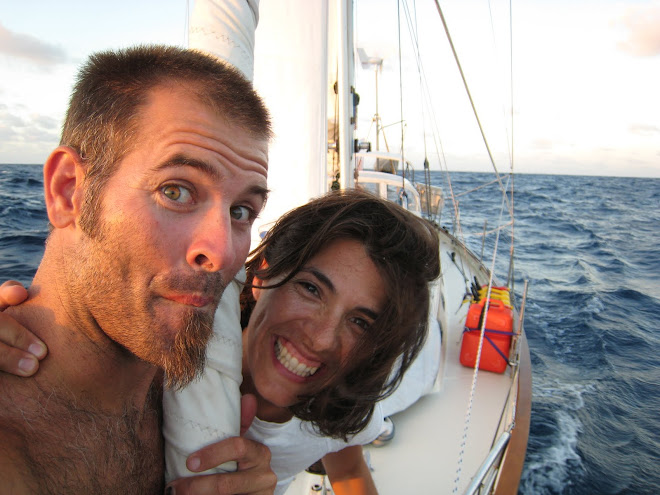
For all you orange ape lovers, you will be happy to know we are starting to upload some shots from Borneo, soon to be followed by a story...
http://svdreamkeeper.com/kumaiborneophotos.php
http://svdreamkeeper.com/indonesialog.php
Just finishing up some boat work and website updates, then time for new adventures in the big city of Singapore, starting with the celebration of our 6 year wedding anniversary tomorrow!
Much love to our people!
--Gar
Showing posts with label Indonesia. Show all posts
Showing posts with label Indonesia. Show all posts
Saturday, September 19, 2009

Monday, September 14, 2009
goodbye southern hemisphere
We crossed the equator for our fourth and final time today. Some things never change here. The heat and humidity sit upon us like heavy wet hot towels, not the welcomed kind you might get in a nice Japanese restaurant but the kind you get when you are sick and have sweat through your cold washcloth. At the equator, the heat is strange, it just kind of stays with you. We sweat all day. A strange kind of sweat in that beads of sweat do not form on our upper lips and foreheads but the kind that just is always there like a slick, a sweaty, sticky, damp slick that forms a thick layer on our skin. Only after the sun slinks below the horizon leaving us in darkness for another twelve hours do we feel a little bit of relief. After we go through the ritual of showering and scrubbing ourselves with soap we feel momentarily fresh and clean, until the wind dries the water left on our skin and our fans can work no harder to cool us. We begin the process again, sweating through our sheets to greet yet another grey morning.
The sun has been predictably veiled by haze for the last 500 miles stretching 100 miles S from Borneo and supposedly reaching as far as Singapore. It is caused by the burning of forest to clear for palm oil plantations, gardens. or peat moss bogs that burn for months. Thankfully we have only smelled the ash on two occasions but it does not bode well for the animals in the forest or the people who live around them. Perhaps it is thanks to the wind that the ash hasn't settled thickly on our boat or in our lungs.
We have been lucky this crossing of the equator. With consistent SE winds at 8-22 knots the miles have passed quickly under our hull. We think the wind also has kept the lightning storms away. Thankfully, we have had only one night with a few flashes that were very far away. This will soon change, as we are less than a hundred miles from Singapore, notorious for its lightning storms.
Cruising is always fluid and our plans have changed again for Singapore. Since the yard manager kindly informed us it has been raining everyday for the last two weeks we opted to skip doing our inspection and haul out there. Instead we will make it to Phuket, Thailand before the end of October to get our survey done and complete our yard work. Now our time in Singapore is flexible and open to anything. We will stay at One Degree Fifteen Marina until our life raft is repacked or until we're ready to move on.
So it is with great thanks that we say goodbye to the southern hemisphere, where we have visited some of the most stunning islands in the world, made friends who have permanently made it into our hearts, and learned some of the many faces of the ocean that have given us the skills and confidence to sail on. Land Ho.
--Nikki
Saturday, September 12, 2009
Dancing with the Big Boys
It's the morning of Day 3 of our passage north towards Batam Island, our last stop in Indonesia before crossing the crazy shipping straits to enter Singapore. Already over 300 miles traveled since we left the muddy river in Kumai, Kalimantan, Borneo, and around 275 miles still to go.
Our Kumai adventure spending time up in the rainforest with the Orangutans, fireflies, crocs, and Probiscis Monkey's was amazing! It ranks up there as one of the highlights of the DK sailing adventure so far. It will be better told as a story illuminated with photos on our website when we can can update again in a week or two. So for now, just know that our brief, yet powerful experience with some our closest relatives, the very orange, hairy, extremely personable orangutans, has left us feeling mixed emotions of joy, respect, but at the same time sadness, as they are pretty much doomed to live much longer in the wild because of loss of habitat.
We have had to move a bit quicker lately, having set up a haul-out appointment in Singapore to have an insurance survey done, and while we're at it, some new bottom paint and a repack of our liferaft. It was a toss up between doing the work in Singapore or Malaysia (prices almost awash), we have opted to just "get 'er done" sooner, rather then later so we can be finished with that business. This means that we will be holed up in Singapore for a likely 2 weeks or so.
Our passage so far has been pretty easy, considering we have been around boat traffic ever since we left the river. Yesterday and the last two nights have been extra exciting, as we have found ourselves in the main shipping lane for transiting cargo ships heading north/south between Indonesia/Australia and Singapore/SE Asia. Back in the Pacific Ocean days we used to be pretty concentrated on just one ship on the radar in our vicinity, paying close attention to it and making sure we alter course if we need to avoid a confrontation with a gigantic steel beast. But now, in the Java and South China Seas, we have gotten used to 5-10 ships on our radar, plus the smaller Indonesian fishing vessels that dart here and there (or are sometimes just anchored), that often don't even show up on the radar. Not to say we don't sometimes get our blood pressure pumping and the hair standing up on the backs of our necks when we are getting to close for comfort. But, like anything, you just get used to it and it becomes less stressful, like driving a car in Bali. The difference is that I started really liking the thrill of driving in Bali, but dodging container ships is just annoying and tiresome.
Nicole has confirmed with me on this passage that we WILL be getting new chart-plotters with an AIS system sometime in the next few months before heading across the Indian Ocean. AIS is an electronic monitoring system that all "large ships" have and now many smaller ones, that lets you receive, or send/receive, your boat information such as course steered, speed, vessel name, captain's name, etc. It reads the information from all boats in your VHF radio vicinity and allows you to monitor the ship's around you. Many of our cruiser friends have this system hooked up now and none of them regret it. It's just one more modern tool you have available nowadays to feel safer around the big boys. But for now, we deal with what we have: our eyes, ears, and our good friend, the radar.
It's now blowing 20 knots from the SE. And the really cool thing is that its BEEN blowing 10-20 knots from the SE ever since we left Kumai. We have read many old cruiser blogs of their experiences up this stretch of water in almost no wind. Motoring, motoring, motoring for days. We think traveling in the beginning of September has helped us out, still on the cusp of the monsoon changing and the transition period beginning. We have also been lucky with no thunderstorms yet. I won't hold my breath on that one, but we are only 90 miles away from the equator and still dry. For those of you that don't know, the area around Singapore is one of the most notorious for huge lightning/thunderstorms in the world. Not to be taken lightly, and super scary as a sailor. We'll cross our fingers and do our best to not offend the weather Gods...better look into that.
Nic's asleep and I have to keep poking my head outside to check the radar for ships. The sky is a white haze and it's so hard to see any vessel unless it's within a few miles, hence the importance of radar. Onward we head to the northern hemisphere again, DK dancing to the music of the Java Sea.
--Gar
Thursday, September 3, 2009
Crossing the Java Sea
After almost 2 months tied up in Bali, we are finally sailing again. Our time in Bali was just what the doctor ordered: fun, interesting, easy, and a perfect place to gear up for the next adventures. We spent almost 5 weeks messing around on the island and additionally pulled off a 2 week surprise visit to the U.S. to see our families. Both adventures so needed to replenish our energy and take a break from the boat for the first time in a year.
So here we go again...
We left Benoa Harbor, Bali, a few days ago, en route to Kalimantan, Borneo, 450 miles to the north.
Once you exit the reefs you are back in the gamut, fighting against the intense southerly currents of Selat Badung channel, as you attempt to head north. Within the hour we had 5 knots against us as we struggled to make miles and the daylight waned. We realized quickly there was no way we would round the eastern tip of Bali before sunset and this would put us in the midst of the hundreds, possibly a thousand, Balinese "spider" sailing canoes launched from the cliffy beaches at nighttime. We didn't like the reality of that for our first night out, thought it over and decided to change course for the touristy island of Lembongan, just across the channel, in hindsight a great decision.
We fought the current for a couple of more hours and then pulled into Lembongan and grabbed a mooring next to our new Italian friends boat, Falabrach. They stopped by to say hello and tell us stories of the surfing adventures, followed by our friends on Magnum, whom we hadn't seen in over a year and had just come up from Australia. So fun to actually see boats we know again and enjoy a bit of cruiser social life after being on our own for so long. It's definitely going to be a real change this year from last, as we are now back on the very traveled cruiser road again.
The next morning we left at sunrise, cup of Bali coffee in hand of course, and motored across the channel towards Bali. We hugged the coast as the wind started piping up and the current intensified. Hours later at the eastern tip we fought the 3 knots against us with 30 knots of wind on our tails, generating some pretty big standing waves. DK kept plugging away and soon enough we were further north away from land with the current diminishing to only 1 1/2 to 2 knots against us. The sun was out and seas were small again and we said good bye to the volcanoes of Bali blurring in the distance.
For whatever reason that first night we found ourselves in a confused mess of water. Swell was coming at us from two directions and with the wind directly on our butt. We were rolling around in a disgustingly agitated way with everything banging and creating some sour-looking glum faces on the both of us. Sleeping sucked and so did the reality that there were fishing boats everywhere.
But thankfully by afternoon the next day the swell and wind were both consistent from the SE and we had a sweet mellow sail on again. As we passed through the small islands north of Bali and entered the Java Sea, we were in the mix of fishing boats, fishing outrigger canoes, and very large ships. Welcome to the Java Sea. At first it was a bit much and was pretty intimidating to be around so many boats, but we realized as time went on that the fishing boats mostly keep their distance, and its only the big ships we really have to worry about. We've heard about how many boats are out in these waters but now we are actually experiencing it, learning to deal with reality of changing course often and having 5-10 boats on your radar at one time. So far so good and sometimes it's not bad at all as all we are really seeing are the small sailing outrigger canoes that scoot around like little flying fish and don't give us any trouble.
So here we are in the middle of the Java Sea, we are almost truly in the "middle" of it now, and the depth is 200 feet. What a trip that is!! We are in a major body of water, at least 150 miles to the nearest land mass of any size, and it is only 200 feet deep. So strange and interesting this archipelago of Indonesia.
We have had our hand-lines out most of the way baited with some cool new lures I ordered from Hawaii, with zero luck. Not even a bite, not yet anyway....only a few fish caught in Indonesia to date, so sad compared to the reality of fishing in the Pacific.
Tomorrow we should arrive to the Kalimantan, Borneo coastline and begin our journey up towards the town of Kumai, the entrance to Tanjung Puting National Park, one of only a handful of places in the world where the orangutan lives. We plan on dropping our hook in the muddy river at Kumai and taking a local klotok Indonesian motorboat up river for 2 or 3 days to visit the various camps and also to see the rainforest. We've been told by many people its a highlight of their whole Indonesian adventure, and I'm sure we won't be disappointed either. I mean really: jungle cruise on a local boat, orangutans, crocodiles, thousands of mosquitos, what's not to like!
That's it from the DK blog station...We'll do our best to get back into our "blog rhythm" again...
Stay tuned for some upcoming Borneo monkey stories...
Big Love from Team DK
--Gar
Monday, July 6, 2009
Finally updating website
Team DK is in Bali. For the first time in many moons we have fast internet access again. That means we are madly sorting and processing through thousands of photos and trying to put them all together for the website.
We should have some new "Journey" stories and many pages of images uploaded within the week.
We should have some new "Journey" stories and many pages of images uploaded within the week.
Thursday, June 25, 2009
Rinca Adventures
We have walked back in time. This landscape is stark, dramatic, and a keeper of hidden life. Hills climb and roll, covered in knee high golden grasses that bow in the wind. Scrubby bushes push their way through the dry earth with leathery green leaves shimmering in the blistering heat. Stark white rocks with ribbons of red stand regally amidst the golden hills, looking like something should be crouched upon them. Long-tall palms reach high into the cornflower blue sky, shedding their skin of old brown jagged leaves as they climb up, up, up, towering at least a hundred and twenty feet high. They rattle when the wind caresses them.
Walking through the nearly dry riverbed in search of dragons we look through the heat, listening. It is never quiet here in daylight. Lizards rustle in the dry brown leaves and scurry from beneath our feet, voles dive into holes upon our approach and a brown long haired wild pig lopes awkwardly away once it senses our presence. Seven komodo dragons lounge in the sun lazily opening and closing their eyes waiting.
The largest of them are over three meters long and weigh as much as 9o kilograms. Their scales resemble armor and their camouflage is so perfected we almost walked into one nestled in some downed logs. These creatures are the largest dragons in the world. They sense their prey with their good eyesight and long yellow snakelike forked tongues. While in this riverbed they look docile and awkward, yet they are good hunters.
They are waiting in the riverbed for the huge water buffalo they attacked to die of its septic wounds inflicted by the bites from the dragons. Once they have bitten their prey, depending on how many bites the animal has and how big it is it will take a week to two weeks to die of its bacteria infested wounds and the dragons will wait to feast. The dragons can sprint on their muscled hind legs lifting their gigantic tails and look like an over pumped steroid filled body builder swaggering like they know they dominate. They can smell blood from 5 kilometers away. And they can swim, not that far but they can swim.
We sat in the riverbed in late afternoon, below 3 dragons lazing on the hill and 5 buffaloes sitting up to their necks in the last pools of water in the riverbed. We sat not 50 feet from one buffalo peacefully listening to him snort and chew. Missing his two lower two front teeth he was almost comical despite his long curved horns and gigantic bulk. Hundreds of small flies circled his head and he responded by dipping his horns gracefully and tossing water about his head. It was really special to be able to sit so close to two species of very powerful animals.
We climbed out of the riverbed back up into the dry hills reveling in the use of our legs again and the stunning views that stretched forever past the hundreds of skinny trunked big leaf headed long-tall palms and over the hammered gold hills to the undulating islands beyond.
Long-tailed macaque monkeys hung above us, eating the fruits of the female palms. The leaves rattled and our sweat dried with the wind. Our guide gambled and asked us if we wanted to walk further to try to find the wild horses if we were lucky. We had wanted to do the 9 k walk this morning but the price for the non-regulation hike was a ridiculous $35 dollars in comparison to $5 for the 5 k hike, so we declined as it just seemed like too much of a scam. We both got lucky. We went for the horses.
Walking quickly through waist high grass, we stumbled over small iron red rocks and past groves of low scrubby trees. We heard the pounding of hooves before we saw 15 black buffalo heading away from us, dust rising from their hooves. They settled under another grove of trees and we watched them while deer bounded through the grass. The sun was sinking and with its descent the dew began to make its appearance. The sharp pungent odors of the grasses and trees revealed themselves as the temperature dropped and the light faded. With the sun in our faces we looked toward the hills to see the elusive wild hoses. Two of them stood regally under a scraggly tree.
There was something magical about that moment, perhaps because we had found them, but likely because we were out in the hills of the park with no one else around, the sun igniting the grasses like fire and our senses fully involved. But we were running out of time.
Navigating through the high grasses strewn with rocks and boulders in deepening twilight in near silence we were reminded of another time in our lives. My thoughts were intermittently interrupted with our guide saying "hati, hati" (careful, careful) after he stumbled on a hidden rock or root. As darkness settled upon us, the big dipper hung above us in the northern sky and more stars began to twinkle. We weren't following an established trail and we likely would have been sleeping under the stars had we had to find our way back to the ranger station alone. After another half hour of slowly heading down hill we made it to the main trail. Thanking our guide and walking back to the boat landing under the star-studded sky we reveled in our tired legs and the longest day of the year, giving thanks that animals and places like this still exist.
Labuanbajo
With our usual ADD tendencies, we woke up, poured a cup and pulled the anchor. It was only 12 miles to the town of Labuanbajo and we were restless to get there, re-provision and move on to Komodo National Park.
Overnight the wind had died and we woke to glassy conditions and a hot ball of sunshine. We motored past and around close to fifty varying sized fishing boats anchored or drifting over the shallow shoals in the bays. Small closely-knit fishing villages sat perched on stilts on the edges of the sea. The waters colors were distinct deeper greens and aqua blues depending on the depth. The hills were covered in thick brown grass and rich volcanic rocks dotted the landscape. Palm trees sprouted intermittently throughout the valleys and draws.
In a couple of hours we were weaving our way through the myriad of islands surrounding the mainland town. We steered clear of the main boat anchorage, choosing instead to anchor 2 miles south of town in front of a little resort called the Bajo Komodo Eco-Lodge, a place we had read about from other sailors, who said they were friendly, accommodating, and helpful to visiting boats. We had also read that the harbormaster in town wasn't always too pleasant, hassling sailboats for extra paperwork and extra rupiah dollars. The town anchorage itself was said to have some petty theft problems. We chose to avoid the harbormaster and town altogether, figuring we'd had enough officialdom for a while and as long as we could stay under the radar outside of town we would be fine.
We dropped our hook in 20 feet of thick sandy mud, the shallowest we have anchored in a year. We have gotten so used to having to anchor in deeper water, often 70-100 feet in Palau and Raja Ampat, dropping in under 50 feet nowadays feels extremely shallow! For all you sailors, our waypoint in front of the resort is: 8˚31.1' S, 119˚52.1' E
There's room for heaps of boats here.
We dinghied in and introduced ourselves to the girls managing the hotel. They were all extremely friendly and very happy to have us around. We were the first boat to have visited in 2009, but when the SailIndonesia rally comes through in July/August they do get many boats anchoring in front of the hotel. Sidenote...Since leaving Palau we have only seen one other sailboat and that is our German friends on the boat, Alk, who left Palau a week before us. We last saw them in Sorong over 2 months ago and since then not one other sailboat.
The hotel was happy to do our laundry, serve us dinner, watch our dinghy on the beach at night, and help us out with getting some diesel. The guys who do maintenance/landscaping working there even shuttled us up one morning to the local fresh food market a bit out of town on their ojeks. On top of all the help from the resort, the anchorage itself was very peaceful, not rolly, safe, and quiet at night. We really couldn't have asked for anyplace better.
The town of Labuanbajo itself is an eclectic little fishing village, weathered and crumbly, but with character. It was fun to walk around and check out the thousands of fish that we think are sardines drying on big nets in the sun on the waterfront. There are a few good shops to get some fresh food, but the fresh food market up the hill is really the way to go. It is great. We went on Saturday morning and it was busy with packs of people and hundreds of stalls set up. Most of the people are Muslim but seemed genuinely happy to have two white tourists poking around their world, bartering for fruits and vegetables, asking funny questions in broken Bahasa Indonesia and taking some photos. Once again we stuck out like sore thumbs and were constantly stared at and followed around, but in a non-threatening way. Overall the people in the market were extremely friendly.
Even though Labuanbajo is a bit of a tourist town, because it is the gateway to Komodo National Park for boats and charters, we think most tourists don't go to the local market, hence the interest in us being there. After an hour, we were loaded up with fresh food for our next adventure to Komodo.
After 2 days we were ready to move on. We had looked into going diving with a boat from town, but the 3 hours each way through the rough currents and winds sounded dreadful. We decided that we were more in the mood for long walks on land rather then more time on boats and in the water. There is a place on north Komodo called Crystal Rock and Castle Rock we still may get to dive on our own. We'll see.
We picked up our clean clothes, said good-bye to all the great people working at the hotel and shoved off for Rinca Island in Komodo National Park.
Wednesday, June 24, 2009
A Beauty of a Passage
Passages come in every flavor. Some are dreadful; you are never comfortable, never dry, or never warm. Fighting currents, wind, dodging fishing boats and floating debris and massive squalls, you are constantly on alert and you don't get much rest, let alone time to pull out a book.
But some passages are gifts from the gods. These are the ones you remember, the ones you cherish. These passages make up for all the bad ones and keep the balance, making sure you remember why you chose to go sailing around the world in the first place. This most recent passage from Ambon to Flores turned out to be one of these, a real gem.
After clearing the Ambon entrance currents once again, this time with nowhere near the confusion of standing waves and squally rainy conditions when we arrived, we set a SW course with a reefed main and unfurled our full 130% Genoa. For the first two days the wind was fairly consistent at 12-25 knots from the SW to the SSW and we had a nice beamish reach with seas only 2-4 feet, our Monitor windvane holding the course easily. Fluffy high-pressure cumulus clouds danced around the sky and the mighty golden orb of the sun kept the heat on in the day. At night it cooled off considerably, our first time reaching for the cockpit blanket to curl up with on watch since, I think, the passage from New Zealand to Fiji over a year ago. At night the stars beamed revealing Saturn, the Southern Cross and Alpha and Beta Centauri, and the huge constellation of Scorpio off to our southeast. The waning moon rose late but had plenty of light still for half the night to illuminate the liquid world we sped through.
Our passage lasted 4 ½ days and was roughly 520 miles in distance. The last half of it we traveled more west then south, heading along the northern coast of Flores, passing through another time zone and entering more of the local fishing areas. The wind grew more spotty and we chose to motor sail off and on, but the seas stayed small and made the trip downright comfortable no matter what our sail plan. We each read two books and listened to plenty of "This American Life" podcasts, great stories to sink into when you can't stare at a book page any longer, especially in the middle of the night.
The last night was our busiest with fishing boats. They seemed to be everywhere and I even had to change course around a set long line with blinking lights everywhere for the net's marking poles. An hour later I was on a collision course with a small fishing prahu boat that was too small to pick up on our radar. We got to within 500 yards of each other and I turned on the spreader lights to light up our decks and show them we were a sailboat, sailing, and instantly he stopped and changed course. Unfortunately, this technique doesn't work with the freighters.
The last day the wind came up strong at 20-30 knots, but we were fighting a 2-knot current against us as we watched the daylight hours tick by trying to arrive at our intended anchorage. In the early afternoon we fought through the even stronger currents to enter the passage through the reefs, but once through, everything mellowed. The winds dropped and the current was nearly flat. We had just rounded the western point of Flores and were now piloting around a group of islands just offshore from the mainland, an arid desert-looking landscape of dry grasses, sandstone and volcanic rocks, and big white sand beaches. Many small fishing villages dotted the shoreline and fishing outriggers and prahus were tacking all over the water.
We rounded the corner in the lee of Pulau Sabibi, anchoring at 8˚22.1' S, 120˚01.0' E in 45-50' of water surrounded by coral reefs and in front of a large sandy beach. A couple of fishing boats were tied up to mangroves close by and another dugout was spearfishing the reef off the point. We were told monkey's lived on shore but we didn't see any.
We had arrived in a whole new world. Dry, hot, and cool at night, not a squall on the horizon. In fact, we didn't see a squall the whole passage and not a drop of rain! So strange. We are so so so very used to getting hammered by at least one thunderstorm or massive rainsquall every day or two, sometimes all day long, that with the absence of that reality, it feels like we have left the tropics. It's sure nice to stay dry and be able to keep our hatches open, but the downside is our boat is coated with a layer of salt and we can't catch rainwater anymore. The latter being the big bummer.
We are happy to be here, ready for new adventures in a new region of Indonesia. Blessings to the sea gods and cold Bintangs for the kids as we stretch out in the cockpit and watch the heat of the sun sink away into the western Flores Sea.
Officialdom in Ambon
We sailed out of the protected anchorage of Bandaneira and watched the volcano, Gunung Api, slowly slip into the sea. Pulau Run could be seen a few miles away. In the hey-dey of the spice trade, the miniscule island of Run was worth a fortune because of the nutmeg growing on it. In 1667 the British actually traded it to the Dutch for North American's island of Manhattan.
We were officially on passage again, but a short one, only 120 miles to the city of Ambon. A steady SE breeze filled in and the seas were only a few feet, overall it looked like it would be a nice sail. Then our instruments went out. All of them. Fun fun fun. For the next 2 hours I tore everything apart where our electronic "sea talk" connections are located. I pulled and looked at every wire. My head was in the bilge, under the steering column, and in the lazarette. It didn't take long for me to feel seasick. Blah. First day out and in the rolly seas and my heads in the bilge, not where I perform the best. Finally, I pulled a larger connection on the autopilot "brain" and 5 minutes later things are working again. Phew! We crossed our fingers and hoped it wouldn't repeat itself. Thankfully it didn't.
After a pleasant sail through the night with clear starry skies we arrived to the current-swept entrance to Ambon harbor where the huge rain squalls awaited us. It was 7 a.m. and Nicole just finished her watch and went below to sleep. I poured a big cup of coffee, bundled up in full raingear and donned the Ipod in its waterproof case. I piloted DK through the chaotic standing waves while the reggae dub beats synched with my morning coffee buzz. The rainsqualls hammered us incessantly and the small prahu fishing boats zigged and zagged around us dragging for tuna as we surfed the currenty standing waves. Finally we rounded the cape and were met by almost glassy conditions in the lee of the Ambon peninsula. It had been an exciting morning. I looked down below at Nicole; she had slept through it all.
An hour of motoring inside the bay while listening to some new NPR's "This American Life" our friend Marit hooked us up with in Misool (Thank You Marit!!), we dropped our hook in front of a small community called Amahusu. About 7 km SW from the main city of Ambon, Amahusu is nice and mellow and there is a beach and hotel there for easy access to shore. It seemed like a fine anchorage, at least at first.
A few hours later I found myself on the back of an ojek (Indonesian motorbike) heading for the harbormaster's office. Once again, long pants, collared shirt, shoes, shaved face, and my officially looking bag carrying all our paperwork, ship's stamps, and rupiah money (for the, just in case, "greasing the wheels" possibilities).
My first taste of Ambon. Much larger then Sorong, our only other Indonesian city to this point, Ambon was bustling with movement and energy. People were everywhere and traffic was busy. Not being much of a tourist city, once again everyone stared, smiled, and yelled "Hello Mister" as I rode by.
Kota Ambon is the capital of the Maluku islands in Indonesia with a population of almost 400,000 people. Most recently, from 1999-2002, unfortunately Ambon was the epicenter of inter-communal violence between the Christian and Muslim people. In 2001, it is said the city looked similar to the 1980's Beirut, torn apart and battle-scarred. Nowadays, the city is once again bustling with life, economic activity, and the religious tensions have eased.
My first trip to the harbormaster was easy. I chatted it up with some of the young office staff, dropped off my paperwork, and then headed to Quarantine. It was dumping again, but luckily I remembered to bring an umbrella and so I plodded onward in the rain. After a few missed attempts at finding the right office, I was directed correctly to an obscure building on a side street where I clomped in wet and muddy. The office workers were all very friendly and after I was shuffled between 5 different officials, all stamping forms or typing papers, I was finished. No one spoke much English and my Bahasa is still poorly inadequate, but we all stumbled through our conversations and I left smiling and thankful that I only had one more stop to make.
I hailed another ojek, my preferred transportation of choice, as they are so much fun and efficient weaving through the crazy streets and busy traffic. Plus, for 5000 rupiah, or about 50 cents, they will take you anywhere in town right away. If you ride the Bemo's, which are the little mini-van's that shuttle people around, they mostly have set stops and routes and, although cheaper at 3000 rupiah, can take 2-3x as long. Plus they are boring.
We zipped through the streets and up the hill on the other side of town to the Immigration office. As I walked in the front door, I crossed my fingers. This was our last "officialdom" hurdle. The only reason we even came to Ambon was to come to this particular office to renew our passport Visa.
Let me just take a minute to explain what we had to do "to even come" to Indonesia. The following explanation may be a bit boring to some of you, but I think it's interesting to note what we have to deal with to visit some of these countries. It all started month's ago, in January, when we were in Palau--
To sail your boat in Indonesia you need 3 things. First is a boat permit called a CAIT. To do this you need to send in the appropriate paperwork and money to an organization that does this service. We used Bali Marina. This takes between 1-2 months. Next you need a sponsorship letter. We also paid Bali Marina for this. Once you have received these two papers you can apply for your passport social visas. To do this you need to send your paperwork, including your CAIT and sponsorship letter and passports, to an official Indonesian Embassy. We FedEx'ed all our papers to a service in San Francisco who deals with Visa's and delivers the paperwork to the Embassy. Sending your passports overseas is pretty scary, hence the use of an agency in the U.S. and using FedEx. Once all this is finished you are "supposedly" allowed to enter Indonesia (it took us about 3 months).
But that's not all. All of these "Visa's" only last so long. Our CAIT is good for 3 months, and then it needs to be extended again, for a maximum allotment of 6 months. Our passport Visa's are only good for 2 months, then need to be renewed each month. To renew our passport Visa we are supposed to have a new sponsorship letter; someone or some organization who is kind of looking after us.
Talk about ridiculous, but here is where it even gets crazier. In 2004 a new Indonesian law was passed stating that sailing yachts were considered luxury goods and needed to have a "bond" of up to 45% of the yacht value placed in an Indonesian bank for the boat to be in this country. At your first Indonesian port you are supposed to pay this fee and when you leave Indonesia you are supposedly to get this money returned in full. There are many problems with this law. First of all, there is no central banking system that you can use to deposit and withdraw from in different parts of Indonesia. Indonesia is huge! There are over 17,000 islands in this country and so many ports to arrive at and leave from. Let's say, for example, we are checking into Sorong in the West Papua region. We should, by law, have to pay our "bond" of up to 45% of the boat's value. A lot of money for us. Then, 6 months later we check out of another part of the country a thousand plus miles away and need to have our bond money returned, but, wait, the "same" bank is nowhere to be found, and even if it was, Indonesia is not known for it's secure and honest methods of dealing with money. Catch my drift??
But here's the deal. Most ports in Indonesia have not been upholding the "bond" law, until this year. Now it seems like many of the "busy" ports like Kupang, in West Timor, and even Benoa, in Bali, want this money. The reality is no sailing boat is crazy enough to pay it. This is creating quite a stir this year in the sailing community. Because of the complexities of Visa's and the bond law, most sailboats coming to Indonesia do so through a rally. The largest one, Sail Indonesia, which leaves from Darwin, Australia, in the middle of July hosts over 100 boats with another 50 or so on the waiting list. They deal with all the Visa's and also put on a number of cultural performances and parties at different stops along their traveled path through many of the islands in this country.
In our case, coming from Palau and entering into Indonesian waters at Sorong, West Papua, joining a rally wasn't an option, nor would we want to join anyway. To each their own, but we can't imagine being with a group of 100 plus boats sailing to most of the same anchorages. Even if the boats do split up a bit, most of the main anchorages still get very busy. For example, the anchorage at Rinca Island in Komodo National Park, where we just came from, is small and tight for a handful of boats. When the rally boats are around this area, supposedly there can be 20 or more boats vying for an anchoring spot in this little wind-swept bay. When we were there it was just us. The reason, however, that most boats, in my opinion, join the rally, is to have it easier with all the Visa's and official paperwork. Many boats are afraid to "do it on their own" or just don't want to spend the time and energy to sort it out themselves. The rally isn't stupid. The bureaucratic mess of paperwork and Visa's in Indonesia really keeps their numbers up and they have a nice little business going. For to join the rally you have to pay a substantial fee as well.
Our first port of entry in Indonesia was Sorong. We gambled checking in here. Because only a few boats a year call on that city, we were hoping they didn't even know about the "bond law". For us, that was the case. Thankfully no one even asked about it and we checked-in with zero problems.
So, back to the present, our last official hurdle: getting an extension to our Visa in Ambon, a place we heard rumors it was possible, but no concrete evidence. The reality was if they wouldn't or couldn't renew our Visa we didn't know what we would do. Nicole maybe would have to fly to Bali with our passports or maybe we would just have to sail straight to Bali and pay big extra fees for being late on renewing our expired Visa's.
I was met at the counter by a few officials, one of them named, Army, who took me under his wing and told me "no problem", we could renew our Visa's there. I breathed a huge sigh of relief.
When I asked Army about whom would "sponsor" us, another unresolved possible obstacle, he said, "you can sponsor yourself". Hello, are you kidding??!! What a concept. For a much smaller fee then what we paid Bali Marina to sponsor us before, about 1/3 of the price, we could just be responsible for ourselves. This is how ridiculous it all is. Army helped me fill out paperwork and told me to come back the next day with Nicole to get our pictures and fingerprints taken. No worries.
We arrived the next day on the back of two ojek's weaving through the rain. This was Nicole's first time off the boat in many days as she'd been sick from the flu. Army met us with a big smile and within an hour we had our pics shot, fingerprints taken, and money delivered, about $40 each for everything. Army told me he could hand deliver our passports that night or in the morning in Amahusu, where we were anchored, as he lived in the village too.
Nicole and I jumped in a Bemo and went to the crazy fresh food market on the waterfront. Wandering the tightly-packed alleys and streets we perused the thousands of colorful stalls filled with things like drying fish, live chickens with their legs bound, cartons of quail eggs, and hundreds of recognizable and not so recognizable fruits and vegetables. Sandwiched between the hordes of people, bicycles, ojeks, and cars, we weaved our way through the masses and periodically stopped to purchase some fresh goodies. Our favorites being the large tasty local avocados. Everywhere we stopped to look closer at the produce, a group of people would gather around us and watch our interactions, curious at the white western people and what we were buying at the market. Everyone was very friendly and within an hour we were weighed down with bags of produce including a few large green coconuts hanging from our fingers. Nicole was exhausted, her first day off the boat and right into this chaotic tumble of energy. We hopped on a couple of ojeks and away we went.
At 7 p.m. that night Army called and said he was at the hotel on shore. I took the dinghy in to the beach, met Army, looked at our new Visa extensions on our passports, shook Army's hand and slipped him some extra rupiah, and we both left with big smiles on our faces. Relieved and so appreciative at how smoothly that had all gone.
Back on the boat, it wasn't so smooth. The swell had managed to wrap itself into the bay and the currents and winds were coming from different directions making our boat roll profusely in every way possible. Bad rolling equals no sleeping.
In the morning I was extremely grumpy having not slept well for the last two nights. We debated what to do as we still needed to officially "check out" with the harbormaster and tomorrow was Friday, which superstitiously is a day you can't start a passage on and we now abide by. If you care to know details about this experience you can read back on our webpage journal "Pacific Passage" from Mexico to the Marquesas for a little story about what happened to us then.
We decided to move the 7 miles of so into the inner protected harbor on the northeast side of Ambon and find a peaceful non-rolly anchorage. We lifted our hook and motored past downtown Ambon and through the narrow passage into the big protected bay. As we passed the Navy station inside the bay, alo and behold, a Navy boat sped up to us with 3 men on board, more like teenage boys wanting to know what we were doing. They spoke broken English and we communicated the best we could where we were going and that we had already checked in with the harbormaster in Ambon, etc. We really didn't want these guys poking around our boat and kept trying to tell them everything was ok and we were just anchoring in the bay because it was so calm. Finally we gave them our mobile phone number and some copies of our paperwork and they left smiling and happy to have had contact with a western sailboat. We dropped our hook in the shallow muddy bay in an area lined with mangroves and small fishing platforms around us. It was a great spot, peaceful, no rolls, and no people except for some fishermen in their dugout canoes traveling to and from their bamboo fishing rafts. We sat out in the cockpit and had a cold Indonesian Bintang sunset beer when, yes, the Navy called. I couldn't understand pretty much anything he said, but in the end he explained to call him "if we had any problems". We both laughed and I said thank you. Nic and I got a total kick out of that. I think they just wanted to call and talk to us. We both slept like the dead that night.
The next day Nic dinghied me over to the shoreline a couple of miles away and I walked up to the road to catch another ojek into town. Zipping along through the Ambon hills we eventually dropped into the densely packed city and I once again returned to immigration to get our clearance paper. It only took half and hour and another ojek ride took me back down to the port to officially check out with the harbormaster. This took a little longer, but within an hour or so I was finished with all our Ambon officialdom business. Phew! A stop at the supermarket and another at the outdoor fresh food market found me with full backpacks, bags, and a carton of eggs. Another ojek ride back down to the lagoon and I was on the beach calling Nic on the handheld VHF to come pick me up. All of it only had taken a few hours. We chilled out the rest of the day, baked bread, made some passage food, read and relaxed in the peaceful lagoon.
Saturday morning arrived and after a leisurely breakfast we lifted the hook, raised our mainsail, and motor-sailed out of the bay. Good Bye and Thank You Ambon. We were now on our way to the island of Flores, 5oo miles to the SW.
Saturday, June 13, 2009
The Flavor of the Bandas
We came to the Bandas Islands to see the old spice trees and remnants of the old spice wars left over from the Dutch and English East India Trading Companies. They fought wars during the 16th and 17th centuries in the remote Bandas Islands for control over the spices: nutmeg, mace, cloves, cinnamon, and peppercorns. We have stumbled over some old canons casually strewn on the side of the street seemingly waiting to be picked up and used later aide from the slick layer of moss that coats them. Stepping through the crumbling doorways of old forts we find it hard to imagine the old days. But on the hook in the stunning natural anchorage with the smoking volcano, Gunung Api and beautifully still bay I can see trading vessels and warships at anchor and can see the town bustling with action. Almost all of that is gone but for some crumbling old buildings and the hope tourism will come back to the Bandas.
Not only are the Bandas an attraction for the historical value and what little spices are still grown but also for the pristine coral reefs and clear waters off many of the islands. Through rainstorms we have snorkeled beside dried lava flows and along Hatta's coral shelves and even along the pier. We have seen some special things but we are also very spoiled and have quickly lost interest in the mandarinfish and pretty waving soft corals.
Mostly, we are appreciating the warmth and kindness of the people here. I have already made friends with three special women I can barely communicate with. A Muslim 18 year old girl who bravely approached me while I was sitting alone on a lava rock beach and proceeded to tell me about her soul mate love and sing me American love songs (the only one I recognized was "Titanic") with an angelically high pitched voice. The rest of our time together we practiced English and Indonesian and we were smiling the entire time. One woman I met at the market buying weird lemons from her (you know the kind with the warts on them that are very sour?) she taught me to say sampai jumpa (my favorite new phrase, meaning see you later), now we see each other in town
daily and I love her. We always depart with each of us laughing and almost shouting, "sampai jumpa" with huge grins on our faces. And then there was the woman in Banda Besar. We met her wandering through the old nutmeg and almond forest where she was collecting almonds, machete in hand barefoot. We came to her through a rainstorm. Then she took us walking through the forest and got us stunningly fresh nutmeg and glowing rose apples. She walked us to the village and wanted nothing. Instead we asked her for lunch and I photographed what I think were her nieces and her mother. We ate an omelet, rice and msg noodles and then had the excuse to pay her for her time. She walked us down old rock steps holding my hand and smiling the entire way. Lucky me.
The remainder of our time in the Bandas has been spent farming out our laundry to Abba's wife Dilla at the Mutiara Guest House and eating scrumptious meals with them, hanging out with our new Italian tourist friend Claudio, doing boat jobs, teaching two abysmal classes of English (remind me to take an ESL class if we ever do this again) and recovering from a nasty flu. We're leaving here with our fist's full of nutmeg, a fully stocked fridge, and a joyful heart.
Sunday, May 24, 2009
Springtime Balance
Written at Misool Eco-Resort, Southern Raja Ampat, West Papua, Indonesia
DK rolls around madly while the southeasterly lumpy swell enters full-force into our tight current swept channel we are residing in next to the dive resort. The wet gray cumulus clouds hang low and the rain falls intermittently fluctuating between a light pitter-patter and downright squally dumps. It was like this all night. We didn't sleep much.
It sure feels like spring here in Raja Ampat. But wait, we are south of the equator again now, only at 2 degrees south, but still south. That means it's autumn. The SW monsoon is starting in Indonesia bringing squally wet conditions to this area and strong consistent SE trade winds more south where we are soon headed. We don't mind the rain, but what does suck is having to close all the hatches and portholes on the boat so that we bob around in our sticky humid sweatbox of a cabin. Without some good airflow we can really feel the dense moisture-filled air we reside in. But with all the rain, our water tanks are sure happy.
On these days it's difficult to appreciate our world. Living in the present is absolutely my most difficult piece to learn in this life. There is no doubt about it. I am one of those people that wants to be everywhere at once, always itching for that greener pasture on the horizon, almost never content with what is. Maybe that's a good thing sometimes to keep my mind awake and to keep me always striving for new challenges. But it sure is tricky sometimes when we are living a very fortunate life on a journey that most people will only dream about. Don't get me wrong. I am very appreciative of my life, of where we are at, of being together with Nicole, of choosing this path. But this time of year is one of my most difficult because it's spring/early summer back in the western U.S. and this has always been my time for mountain and desert adventures. Man, this year I sure do miss Yosemite. I miss the connection with my climbing bro, Billy, and our dirt-bagging weeks we would spend getting spanked on the granite walls of the valley. I miss the rawness, the gripping fear of potentially taking a huge fall halfway up El Cap, the relief and wonder at the end of the day sitting on our porta-ledge scraping cold beans into our mouths with freshly torn-up hands. I miss the deep fresh green of a wet El Cap meadows and the mighty Merced River cleansing the forest and bringing the freezing cold alpine water down from the snow-packed high country.
Or cragging in Joshua Tree with a group of compadres. Living simply in Hidden Valley campground, telling stories around the campfire while the coyotes howl in the nearby rocky outcrops. The wildflowers are popping and the cool nights are perfect for sleeping soundly under the stars. Sinking my digits into the jagged cracks of Illusion Dweller or having an all day Wonderland adventure out at the Big Horn Sheep Mating Grotto. And, of course, wrapping up the day with some cold Mexican cervezas at the monkey-like Gunsmoke Traverse until your trashed fingers just can't take the sharp monzonite anymore. Oh, J.Tree...what a special place.
It's springtime and just so hard for me to resist California mountain and desert dreaming...
And, lastly, I miss our people. Our little tribe of friends we connect with, sharing adventures, laughs, and stories. Springtime has always been about creating some form of active outing with a close friend or a whole group of rascals---coming out of the contemplative wintertime and rejuvenating our spirits with some form of outdoor camping gathering. Yes, all of you out there are missed. You know who you are.
But this year we find ourselves in southern Raja Ampat, a true gem of a spot as well. Since leaving Sorong harbor and our whirlwind checkout and reprovision process, we took almost a week to make it to this special little eco-resort/conservation center. It seems we left the slicks of trash behind in the northern Raja Ampat islands thankfully, and island hopping down in this area has only brought more gorgeous limestone rocks, dry, yet seemingly jungly landscapes, and more green nutrient-rich water filled with the most beautiful soft corals, huge schools of reef fish and fusiliers, and some very special little underwater critters we have seen no where else.
The parrots, cockatoos, and sea eagles still fly over our mast and have been joined by the occasional hornbill and kingfisher. This area is a special place and it is no wonder why Andrew and Marit, the managers of this little dive eco-resort, have chosen to set-up shop here and help protect this area from all the illegal fishing that threatens to gobble all the amazing underwater world here up. The resort has an agreement with the village who owns these islands and water around them, to build and run this small resort for so many years, as well as to protect the area from the stealthy long-liners that show up at night in the nearby waters. The resort employs over 40 staff, almost all who come from the villages that own this area, so it truly is a very win/win situation for all. For the local people, for the lucky tourists who get to spend time here, for the managers who get to reside and work here, and for the wildlife and fish that now have a chance.
We, of course, feel lucky that we have chosen and have been allowed to hang here for a while, tying up DK on their mooring and allowing us free run of the place in and out of the water. We have slowed down again, spending time underwater blowing bubbles with the critters, chatting and eating delicious Thai food with Marit and her staff, swimming laps over the shallow coral reefs, taking photos, writing, and putting some new coats of varnish on the cockpit teak. We aren't in much of a hurry right now, so it has been nice to just "be" here for a while.
So we find ourselves in the tropics for another spring, I mean autumn, and the balancing act continues...continuing the work of being awake in our present surroundings, yet still appreciating those special places and people back home that we love and miss dearly as well.
Saturday, May 23, 2009
We Got Lucky
We got lucky. We made it in and out of Sorong in 24 hours. We have never succeeded in fueling, checking in and out of a city, hung out with new friends and reprovisioned in one day. Like I said, we got lucky.
Passing rusty dilapidated wrecks, Philippine fishing fleets with outstretched arms, and local dugouts equipped with the familiar "putt putt putt" of a very powerful lawnmower engine we motored into Sorong's outer harbor following our friends' waypoint to the "fuel barge" on Sunday. We passed a village with over a hundred people lining the beach and searched for the rusty black wreck across from the fuel barge that was supposed to be our marker.
A man lingered in the doorway of a very new white vessel with what looked like barrels on deck, so we did a drive by. "Bagi. Solar?" I enquired hopefully. "Solar," (diesel), the man pointed across the shore. We motored to what we thought was the fuel barge. "Solar, hari ini?" Today, I asked hopefully. "Ya, Ya," came the response as more and more young men poured out of the barge onto the deck. The sky over Sorong city darkened as cumulus clouds began to ascend higher and higher yet somehow they never reached the scorching sun above us. Boom, Boom, the thunder roared. Still we were cooking.
Our friends had gone through this routine a couple of weeks ago and warned us it would be a really messy fuel because of their high-pressure hose. But it was cheap at 6000 rupies a liter equaling about $2.40 US a gallon and we needed to top up. So after using our rudimentary Bahasa and consulting with one of the young guys working at the barge we negotiated the price of 6000 rupies a liter, communicated we wanted 270 liters (giving us 5 extra gallons of space for overflow with the high pressure hose), found a small hose fitting to work with our deck fill, got to inspect the amber clean looking diesel and then, finally, fuel. The guys were thoughtful, making sure Gar knew the meter was at zero when they started and they did an excellent job making the connection between huge fuel hose and our tiny one. Within 20 minutes, after 15 guys participated or watched the process, we were fueled without spilling a drop, had photos taken of us by them and the other way around and paid with a receipt to prove it.
Next on the list was where to berth for the night. We called our new friends, Dave and Din on Shakti, a live-aboard boat, hopeful they were in town and wouldn't mind moving, or on a charter and their mooring was free. Again we got lucky. Dave's crew moved Shakti to a steel mooring and we took her oversized plastic one. Visiting Shakti later that afternoon we learned we might have fueled from an illegal fuel barge owned by an illegal logger. Well, there was a police boat side tied to it. I guess that doesn't mean much. OOPS. Even when we try to be conscious maybe we aren't. The extra bonus was that we could hang out with our new friends and also a friend I originally met in Palau years ago who now lives in the Bay.
Monday morning started at dark thirty when we woke with the sickeningly sweet putrid smell of fish mixed with oil flowing past our hull and the loud "putt putt putt" of local boats motoring close by. We rocked in their wakes and dressed for the officials. Gar and I were wearing long pants, shoes and button down shirts for the second time in less than three weeks. This time we got smarter though. We motored super dingy directly in front of the harbormaster's office, swirling past plastic, fish, and coconuts and side tied to an old engineless boat. I wished Gar luck while I sat in the sun guarding the dingy and watching kids playing in the water while waiting for his return.
During the hour I waited for Gar the local kids entertained me. Shanti was the bravest. After about twenty minutes of me smiling and all of them staring at me directly or out of the corner of their eyes she finally approached, sticking her wet belly out and shaking her curly hair so I could see the water clinging to her Papuan curls. "Good morning my friend," she blurted out in English and readied to return to her 6 friends watching from a safe distance. "Good morning my friend", I replied. "What is your name?" "Shanti," she said through sparkling white teeth. And then, just like that, we were friends. She sat next to me or did jumps off the pier always looking back for a thumbs up. The boys got braver and started sidling up beside me and we talked about the tiny dried shrimp that sat beside us getting smaller and smaller in the baking sun. Well, we didn't talk really. They talked in Bahasa Indonesian and I talked in English. It worked though and before long Gar returned.
I knew we were good when Gar strode down the dock smiling with a big thumbs up. He narrowly escaped the all day run around to Immigration, Customs, and Quarantine and to play host to the harbormaster on the boat. This was the third harbormaster he had met in Sorong and he wanted to send Gar to do more paperwork and to see DreamKeeper. Luck was still with us as Gar managed to smile a lot, make jokes, sit relaxed in his office and tell him he was welcome to the boat but it was all the way down the harbor. Instead, the harbormaster signed and stamped our exit papers and were clear to leave without more officialdom.
Only two more things on our list: Fill the gas jerry jug for super dingy and provision. We were doing great, it was only 10:30am. Gar sauntered down the pier to the petrol station and returned within minutes. We said goodbye to my new friends after they helped us untie Super Dingy and we were off to find a pier closer to Saga, the supermarket and DK to drop me off on.
Cruising past large fishing boats packed together like sardines, put put boats, and large ferries we found a dock peeking out of it all that had a ladder leading up from the sea. I hoped I could find Saga and return to the same pier with all of the groceries. You see there is nowhere to safely leave the dingy so I was alone on this mission and my sense of direction isn't my strong point. Walking through thirty men lingering on the dirt side road saying "Bagi," morning to all I almost made it out without conversation until a man stopped me and smiled. We shared morning pleasantries and then I asked him where Saga was, hopeful I might be able to walk. Left right right he motioned with his hand. And I was off.
Navigating over pot holes and bamboo poles, passing a motorcycle shop, beauty salon and shops selling everything made of plastic I was distracted, waving to kids in uniform, who shouted, "good morning mister" or "good morning misses" from across lanes of traffic smiling and waving frantically. At last I made it to the salmon pink building that was home to Saga. Shopping was uneventful except they didn't have eggs. Well chicken eggs. They had spotted brown and beige quail eggs and some pinkish eggs and some big blue eggs but no chicken eggs.
By noon I was calling Gar from the back of my taxi on the VHF. He heard me and asked if I was on the same pier. I don't know who was more surprised that I was, Gar or me. The backup plan was that he would just cruise the waterfront looking at all of the piers. No need. So after getting severely ripped off from the cab, two dollars, with help to lug all 12 bags of groceries out of his van we debated returning to town for eggs.
We decided leaving Sorong was much higher on our list. We b-lined it back to Dreamkeeper and a little after noon we were free from our mooring and headed out the channel with the tide. Goodbye Sorong.
Saturday, May 16, 2009
Another First
Written at Pulau Wagmag, Southern Raja Ampat, Indonesia
It was another first. In the last 2 1/2 years cruising on DK we have had a full cornucopia of adventures. But every so often something brand new and randomly exciting happens. Today was one of those days.
But first a little background...Anchored at the northern Raja Ampat island of Wayag, almost everyday was about exploration. The island massif and surrounding mushroom-shaped rocks surfacing from the sea are equally dramatic and beautiful. Sandy beaches line the shores of the reef-encircled small bays and lagoons and the channels are alive with thick nutrient-rich currents that support the tremendous amount of life that exists here. This small area in West Papua, Indonesia, is considered to have the greatest coral reef biodiversity of its size in the world. Even though the secret is out and more and more tourists venture here, mostly on live-aboard dive boats, the reality is that Raja Ampat is still seldom visited and only a select few actually spend the money and time to journey to these islands.
There has been a rather sad downside to this gem of a region. Even though we have been at least 40-120 miles away from any significantly sized city, like Sorong, we have seen more trash in the water and on every beach we have visited than anywhere we been in the Pacific Ocean. Slicks of plastic, foam, steel balls, flip-flops, and all sizes of wood and bamboo are pushed and pulled by the strong currents. Every beach we have walked on is practically covered with rubbish and when we do put our fishing lures out in the open water trying our luck for Spanish mackerel or tuna, we mostly just catch plastic. It's been a full time job just pulling in our lures to remove the pieces of trash we hook, not to mention keeping a sharp lookout that DK doesn't ram into a huge log or scary steel whatever. Some locals say the trash is from the live-aboard dive boats and others have told us they think it is the huge fishing or container ships that are heading to Sorong but don't want to pay to have their trash brought on shore, so these boats just dump it before getting close to the harbor. This is all possible; we really don't know where it comes from or why it is so bad. The happy side to this reality is that it sounds like most of the time there hasn't been this problem with trash, but, unfortunately, while we were visiting trash everywhere was our reality.
Back to the present...Nicole and I took off in Super Dinghy for an around the islands exploration tour in an attempt to find a "shady" beach. Did I mention it is really really hot here at the equator? Zigging and zagging through the coral-studded channels of the inner lagoons we soon found ourselves on the outer reef skimming along the top of a shallow hard coral reef. "There's another turtle," I pointed out, one of probably half a dozen we had already seen that day. But as we got closer we could tell something wasn't right. The turtle was clearly struggling and kept surfacing in the same spot. We slowly approached and could finally see the problem. The turtle was trapped in an old fishing net with it bound tightly around 3 of the turtle's flippers and completely around it's neck. Our hearts dropped. This is what you read about; the thousands of old fishing nets and plastic 6-pack rings that float around aimlessly in the oceans entangling anything that gets in their way. But this situation was our first time actually observing this sad reality.
But now wasn't the time to be sad and introspective. It was time to act. 'Bummer', Nic and I thought. No knife. No mask. And we were miles away from DreamKeeper. I looked at the turtle coming up for air and immediately attempting to dive and swim away unsuccessfully. It was scared and it was really stuck. Then I remembered we "did" have a knife with us. A fishing knife I left yesterday under the dingy seat when I was out hunting for lobster. We almost never keep a knife in the dingy, well we didn't, but we all know now that will change.
I jumped in with the knife and struggled to hold onto the turtle. It was a green sea turtle, fairly large and heavy, possibly 2 1/2 feet in diameter and weighing at least 300 pounds or more. It didn't want anything to do with me. It struggled and kept diving down while I attempted to find some purchase with my bare-feet on the hard coral that I could just barely touch beneath me. I finally got a good hold on the turtle's shell and managed to cut a few pieces of the net off. Then the turtle slipped away again and down it went. My fear was that I would cut only part of the net away and the turtle would take off with some of it still wrapped tightly around it's flippers or neck only t0 be killed by it at a later date.
Nicole was circling in the dingy yelling for me to be careful and not to hurt the turtle or let it get away. She was clearly rattled and was just trying to voice her concerns, but for me, as she well knows, it was better to just tune her out and focus on the situation.
Finally I managed to pull the turtle close to me again and this time I held on tightly to it's shell while doing my best not to drag my "white-man" bare-feet all over the sharp coral my toes were clinging too. Thankfully the turtle was tiring and I was committed this time. I carefully slipped the blade between skin and net and slowly freed each limb. I was nervous about the neck, but as I worked the turtle seemed to relax a bit and eventually I cut the last of its bonds. I released my firm grip and the turtle finned fiercely, dove deep, and was gone. It all happened in only a few minutes.
I bobbed in the water and appreciated the moment.
The trash we had been seeing finally had a more real connection. Of course the net probably wasn't just thrown overboard by a live-aboard dive boat or container ship coming into Sorong, but it was "trash". An old fishing net lost at sea wrapping up everything in its path until it becomes caught on a coral reef, beach, or boat prop. In this case it snagged a turtle.
For whatever reason we came upon this situation, it was a first for us, and thankfully, had a happy ending.
Friday, May 8, 2009
The Four Kings
Written and sent from Uranie Island, North Raja Ampat, Indonesia
Raja Ampat was always one of those mythical places we had only heard reverent stories about. Fittingly, the name is the stuff of legend and means "four kings". It is now well known because of the tremendous species diversity that resides here both above and below the water. Raja Ampat's reefs have been referred to as "a species factory."
Even the rocks are alive in northern Raja Ampat. Jagged sharp limestone islands are undercut by the consistent presence of the sea all around them. Trees cling to whatever soil and rock their roots can find on the seemingly inhospitable earth. As the swell gently rolls in, the rocks breathe, gurgling loudly with the intake of water and hiss violently as it is caught in air pockets and pushed back out.
Under the islands' lips hundreds of fish gather in the nutrient filled water. Currents meet here, bringing with them vast amounts of nutrients. This is why there are hundreds of sweetlips big enough to be on steroids staring at use with pursed lips, while schools of bumphead parrotfish move as an organized unit, gorging on the abundance of coral. Juvenile turtles and sharks patrol the reefs and butterfly fish the size of salad plates lazily meander by.
It because of these currents and this life we chose to visit Kri Island and eco-resort to dive. We motored 40 miles north of Sorong past fishing boats with long arms, through pods of leaping spinner dolphins, maneuvering through boiling currents and whirlpool eddies to arrive in the early afternoon with a current pumping against us at 2.6 knots. We passed back and forth in front of the resort searching for a shallow spot. Yet, we were told to anchor in 35-45 meters (110-135 feet) 250 meters off the resort, really deep for us. We debated trying it or abandoning our diving plans for Kri. We searched for anything shallower and found nothing.
So we committed and dropped all 280 feet of our chain attached our 300 foot piece of mega braid line and let 100 feet of that out and waited. The current was racing past DK's hull and I stared wide-eyed finger on the line hoping she would hold while Gar backed down on her hard. We'd never anchored this deep before or in current this strong. She held. The anchor jumped a few times against the bottom and then stuck, the line quaked as the sea rushed by if it was mirroring my own nervousness.
We stayed and swung for four days back and forth on our anchor in front of the channel leading to the resort where we were welcome to make our new home. Diving three times a day and eating scrumptious meals in between at Kri eco-resort we returned to DK only after dinner and the tide would allow us to escape from the channel we parked super dingy in. Did I mention how lucky we are.
If you look carefully through the nutrient rich water there are wonderfully beautiful and startlingly ugly creatures that make Raja Ampat home. Nudibranchs of every size, color, and pattern imaginable can be found on sand flats, in the arms of branching Acropora coral, and under the edges of rocks. I saw a baby pink scorpion fish the size of my thumb and we have seen three species of pygmy sea horses, stealthily camouflaged in sea fans. Mantas appear literally out of the blue like phantom angels. Walls are plastered with corals, tunicates, sponges, fans, and sea whips with colors and patterns so wild they would make Dr Seuss grin.
Leaving Kri we headed north back across the equator and to the islands that first called to us up in Wayag. The surface of the water glows in an otherworldly aqua green and quickly changes to midnight blue as we search for anchorages beside the deep craggy islands. A sea eagle has just stretched her white wings and landed in a snag above us while red parrots pass by squack squaking until they find a good spot to roost. Small birds tweet tweet tweet in the mornings and evenings and something whack whak whaks early in twilight of morning.
We spend our days getting up early to sand and varnish DK's weathered teak and try unsuccessfully to hide from the heat of midday. In the afternoons, at high tide we slip into the sea to search for whatever she is willing to reveal. Swimming through a sea of mirrors, schools of thousands of silver blue sardines and fusiliers we see blue spotted rays munching on critters hidden under the fine white sand. Spanish Mackerel, barracuda and giant trevally make elusive quick passes hinting at what lives deeper in the channels. After hours in this other world we return to Dream Keeper water logged.
At dusk the rain starts. It is not a normal rain as no none hits our deck but one that bubbles up from the sea. A constant gentle pitter patter of rain drops begins reliably at dusk and continues into the night even when the sky is cloudless and sparkling with the stars of the southern cross, Orion and the dipper. Fish really are everywhere in Raja Ampat; the rain comes from them feeding on the surface.
But all is not well with the Four Kings. While there is incredible species diversity here and it has been recognized by some big NGO's and the Indonesian government as a marine hotspot well worth protecting it is not immune to human impacts. Thick trails of trash ride in on the currents and a nickel mine is planned on one of the northern islands. Illegal logging threatens to choke the reefs and gas and oil prospectors visit the region searching for liquid gold. Let alone the pressures from local subsistence fisherman cyanide and blasting the reef and international fishing fleets that threaten to leave this kingdom destroyed and empty.
With hope to be recognized as a World Heritage site and efforts being made to protect the 3,500 square miles of newly formed marine protected areas we hope the crown jewel can be defended and will remain sacred so that Raja Ampat will not only be remembered in myths.
Monday, April 27, 2009
Farewell Palau
Our passage was a gift that lead us to an even grander one here on Helen Island. We sailed under double-reefed main and alternately with a reefed jib that unfurled to its full 130% as the wind continued to decrease by the end of the passage. Leaving Koror after a swift check out our sails were filled with wind from the NE at 20-30 knots. The first day and through most of the first night we flew across the ocean on a broad reach sailing at 7-8.5 knots. The swell was small and the squalls sparse. Perfect ocean sailing. The moon filled the sky and threw light across the empty horizon almost as if it were twilight all night long. As the wind decreased we learned to appreciate slowing down as we had to arrive at Helen Reef in good light and favorable tide to clearly navigate the reefs. We have never really appreciated moving at 2-4 knots an hour but riding with perfectly set sails and a small swell with the moon shining through gossamer clouds and the squalls steering clear of us we did. I can't remember loving sailing this much or having a passage so peaceful.
It was a perfect way to come into Helen Reef, 350 miles away from Koror. After being guided through the maze of patch reefs by the Helen Rangers we fell in love with the place and our new friends. The light reveals Helen Reef in all of her beauty; reefs glow from the depths shimmering turquoise from the shallows, terns fly by the hundreds and turtles are everywhere. We spent our days fishing with the rangers who we are now grateful to call our friends, feasting on their catch, walking the beach searching for turtle tracks and watching the light change over the water. When night falls on Helen Island we listen to the black noddy terns and spent hours talking story and sharing meals with the guys, waiting for turtles to come ashore to lay their eggs.
We settled into a comfortable rhythm with David, Hercules and Paul and the island. They quickly became our new friends and the island our home. I could have stayed there for months it felt that good. And then it was over, we were overdue to arrive in Sorong with only 60 days to our visas and the weather looked good to go. It was with tear filled eyes we followed our track through the maze of patch reefs and let Helen slip into our memories.
Watch for a longer update with photos once we have internet connection again. (Unfortunately, it may be months)
***Sorry these last 2 blogs are out of order***
Sunday, April 26, 2009
Selamat Datang Di Indonesia
Let me be blunt, sailing a yacht around the world is nowhere near as dangerous as riding in a taxicab in Indonesia. It took us a whole 2 days since we placed our feet on Indonesian soil for us to be involved in our first "agro" taxicab race. Let me set the scene...
Picture a bustling, garbage-strewn, fish-stinking small oil and shipping city flowing with all types of Indonesian peoples. Short black-skinned Papuan locals share the spaces with more lighter-skinned taller Indonesians who have migrated here from Ambon, Timor, and Java. Ghetto shanties mix with concrete first-world shops, temples, and banks, all connected with muddy pot-holed roads and sidewalks trenched by the thousands of sandaled-feet who have trod the muddy paths through the trash and what once could be called grass. Taxis and motorbikes flow into a continuous smoke-belching river of chaos where the only unspoken rule is to go as fast as your vehicle will allow and obey only the signs you choose.
We are on our way to the supermarket, Mega. I'm in the front seat of the little mini-van taxi, torn vinyl seats, windows too low to see well out of, and scratchy Indonesian music blaring from the bad speakers. Nicole is in the very back seat with 2 other women sandwiched in next to her. Our driver guns the engine and attempts to pass another taxi. The other taxi decides that no way is he going to let our driver pass him. We are on a smaller side street with cars and motorbikes coming directly at us. We have to pull back behind the other taxi with inches to spare from hitting his rear fender. Our driver is furious. We try again, same thing. He is livid. We turn the corner and he guns the engine again, do or die it seems. We are neck and neck, inches separate the two steel bodies and the oncoming traffic is forced almost into the ditch. All of a sudden a bigger car is coming right at us, no room, and we are going at about 40 miles an hour now on a busy little 2 way street with no room for error. No way our driver will back down now because he is a winner...he pulls in front of the other taxi, scraping our steel panels together just in the nick of time before we end up in a head-on accident...did I mention I am in the front seat with, of course, no seatbelt. Seatbelts, in Indonesia, what are those??
We pull over to the side of the road. Our driver leaps out and goes over to the other taxi yelling curses with fumes coming out of his middle-aged nostrils. I look back at Nicole and we share an unspoken sigh of relief. Good thing Indonesian culture is mostly non-violent. No fight ensues, our driver returns, and off we go again at top speed. Time for us to change taxis.
So we made it to Sorong, Indonesia. It wasn't easy traveling south from Helen Reef in Palau. It only took us a few days but we had one night of junk full of large confused waves, 30 plus knots of wind, and massive squalls dumping buckets of rain all night long. We intelligently chose to hove-to and I ended up sleeping on the cabin floor in the bouncy conditions for a few hours until the sunrise brought a welcome change of weather and we set sail due south for the equator.
Motoring in zero wind on our last day we crossed the 25-mile stretch of water that separates the island of Pulau Waigeo from the Papuan mainland where Sorong lies. We came across a huge school of dolphins and a few fin whales surfaced nearby before the water slowly started getting more trash-filled and turning brown.
We dropped our hook and backed towards the concrete wall in front of a building in the northern section of the harbor. Our German friends, Harry and Heidi, on the yacht, Alk, were waiting for us. We side-tied next to them and they caught us up on their welcome to Sorong adventures.
A couple of day's prior, Harry had his go at checking in with all the officials: the harbormaster, customs, quarantine/health, and immigration. They gave him the full run-around and it ended taking him over 12 hours and having 8 guys from customs and immigration searching every cubbie on their boat for an hour at 7:00 at night. He had to pay a guy to be his "agent" and ended up forking out around $70-80 to get all properly sorted.
My day took roughly 6 hours, with a few of them spent in taxis and on the back of motorbikes searching for the various obscure offices I needed to find. I spent many hours just talking story in my broken Bahasa Indonesia and their broken English, chuckling, and smiling as I sat in their offices and filled out forms. Only one customs officer wanted to actually walk on our boat and it was clear he wasn't really into it. Total cost for all of it, $15. After that we were officially cleared in and I could take off my sweat-soaked collared shirt, pants, and close-toed shoes I wore to make a good impression. I had even taken out my earrings and shaved my WHOLE face. Nicole was pretty happy about that (but don't get used to it, girl).
We are alone now; our German friends have headed south. DK bobs in the brown, stinky trashy water with a constant parade of on-lookers on the bulkhead 30 feet away from us. The men stare for hours and the kids yell, "Hello Mister", every few minutes. We are truly a spectacle here in Sorong, as this is neither a tourist town, nor a "yachty" place at all. Our boat sticks out like a sore thumb surrounded by Chinese style junks and humungous Philippino outrigger fishing boats. On one side of us the oil tankers dock and on the other side the enormous "love boat"-style ferries tie up that shuttle the masses to Papua New Guinea every few days. In another day we will be off to Raja Ampat, our time in Sorong being the price we pay to get to experience the beauty of our next destination.
Subscribe to:
Posts (Atom)


