Showing posts with label Red Sea. Show all posts

Monday, May 24, 2010

God Willing


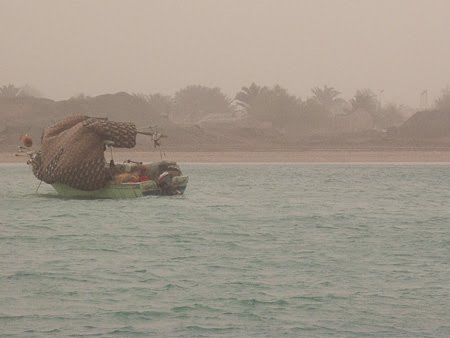
At last, the Red Sea gave us a window to escape. For three days we watched the wind push storm clouds of dust running across the desert, swirling over the nearby mountains and out over the sea. We kept our eyes on the small fishing boats at anchor and laughed with the locals, shrugging our shoulders and shaking our heads about the sand storm and wild seas. Peering out our portholes, we were grateful we were on DK and not on one of the many fishing boats tossing at anchor with their shade-cloths billowing up and down like unwieldy circus tents.

On May 20, at 06:00 we upped anchor from Ras Abu Zenima. The wind still howled at us us but the seas were manageable. By nine am, the wind continued to build and the seas reared up and threatened to stop us in our tracks again. We had learned our lesson and tucked into Ras Malab at 29.12.1998N, 32.55.814E after a surprisingly blustery but gentle 12 miles north. We gratefully celebrated our wise choice when the wind picked up at noon to 30 knots and we were bouncing around again at anchor. Mentally exhausted, we declared the rest of the day a holiday and lounged around, baked cookies, and watched a matinee. All day the wind picked up, surging past our hull and licking us with salt spray. By 19:00 we were humbled by its strength, blowing constantly at 32 knots, often gusting to 37, the strongest we’d yet seen in the Red Sea.

For those of you who don’t know boats, when it’s this windy it’s really loud. Secured lines bounce, rattle, and buzz. The anchor snubber moans in protest against the wind, and the boat, even when protected from the seas by a shallow reef, continues to roll like we are on passage in moderate but sloppy seas. Here conditions were too raucous to get any sleep in the V-berth in the front of DK (our normal bed), even with one of us wedged horizontally across it. For the first time ever, we made two sea berths in the salon that night. Well into the wee hours the seas slapped us and tossed us around, our hopes dwindling that conditions would allow us to leave by morning.

On May 21st we awoke with our alarms at 05:00 to blustery conditions. Resigned to be stuck another day, we tucked ourselves back into our cozy berths for a couple more hours. But by 07:00 the wind seemed manageable and we again headed up the coast, hopeful we could make the 15 miles to Ras Sudur before the wind barred our passage again. Successfully, we made it by 13:00 in strong winds but decent time. We tucked in at 29.35.135N, 32.41.231E in 16 feet of water next to a pod of resting dolphins. The wind predictably kicked up again within a couple of hours and we were glad we were learning to be patient.


We had twenty five miles to go to Pt Suez Yacht Club, our entrance to the Suez Canal. At 05:30 on May 22, we greeted the chilly morning bundled again in our foul weather pants and jackets. The captain even wore a wool hat. It was dead calm, eerily so. A few fish broke the surface and terns dove overhead. By 10:00, the sun was merciless again. Spinner dolphins escorted us the last 10 miles through swarms of purple jellyfish and into the Suez Harbor.

By noon we were ecstatic and relieved to have made it to Pt Suez, the mouth or the tail of the Suez Canal depending on how you look at it. Our journey up the Red Sea was at last behind us. Kar Kar, the marina man and, Sayed, our agent from Felix Maritime tied us to our mooring. Within minutes Sayed had our paperwork completed and said that “Insha'Allah, (God willing) we could head up the canal the next day if it wasn’t too late for the measurer to come and there were no warships transiting in the morning.” Then we would be lucky and we could proceed north. “Maybe yes, maybe no” he said. “Insha'Allah.”

God was willing. By 16:00 we had been measured, and after some back and forth, Gar and the measurer agreed upon the calculations for our tonnage and canal transit price. The next morning, we rose to crisp clear skies, calm winds and the promising possibility we would be heading north up the Suez Canal. After calling our agent numerous times to no avail he showed up at 9:30 with our bill. Of course it was higher than we had agreed upon with the measurer. This is Egypt after all. After some stern talks and haggling over the difference, we reduced the fees to what they should have been. In the end, we were charged $288 dollars for our canal transit, port and agent fees, $21 dollars for our night on the mooring balls and an extra $5 dollars here and there for baksheesh (bribes, greasing the wheels, Egyptian custom, whatever you want to call it) along with a couple of boxes of cigarettes (on board specifically for this purpose) and our broken VHF.

I had the bonus of having a very sweet old man do my shopping for me at only a moderately inflated price. Freshies abound again on DK and our pilot will hopefully be happy with a feast for lunch including green beans, carrots, tomatoes, cucumbers, melons, eggplant and fresh Egyptian bread among other things. The best part about my grocery resupply was that it came from an adorable old man with a stunning smile and a winning sales act. I received many kisses, a promise of him as my second husband, and a belly full of laughter before we agreed on a shopping list and a price. If only dealing with all Egyptians were as delightful as this.

At 10:25 our canal pilot took the helm. DreamKeeper’s rpms were revved to a fast but easy 2500 and our pilot steered us on up to Ismalia, adding another run to his 15 years of canal piloting. He is serious and scholarly looking with round frameless glasses, a long face, and tightly cropped hair and beard. The dark callouses in the middle of his forehead mark his dedication to prayer and Allah.

It is wild to think of our journey up the Red Sea coming to a close with the final miles through the man-made canal that is Egypt’s lifeline to the rest of the world. The work to create the first canal that separated Africa from Asia and connected her to the Mediterranean was first recorded in 610-595 BC. For a few hundred years numerous Egyptian rulers and conquerors worked to build and maintain the original canal running through a different and more complicated route that was later abandoned. In 1859, the excavation of the current Suez Canal was begun and in 1956 Egypt fought and won control over the rights and ownership of it.

The Suez Canal is now the one of the most heavily used shipping lanes in the world with over 20,000 ships a year transiting its waters. It runs 167 km in length from Port Suez to Port Said, running through a few large lakes and a waiting basin and yacht club in Ismalia. In some places it is wide enough for a large ship and a small one like ours to squeeze closely passed one another but not wide enough for two large ships to pass each other at once. So there are specific transit times for northbound and south bound boats. The cut off time to head north from Port Suez is 11:00. At 10:30 we were one of the last small northbound boats transiting the canal. Our pilot Mohammed Ebrahim Ali was excellent. He was competent and courteous and hand steered our boat with constant attention to the conditions. He skillfully navigated the canal and passed 28 gigantic ships heading south on our way north to our mooring for the night in Ismalia.

By 17:30 we were med-moored stern to in Ismalia to the entertainment of a large family of Egyptians watching just feet away from our cockpit. We’ll likely spend a day or so here. The weather looks like it will be favorable in the Med in a couple of days and we’ve got diesel runs to do and a re-provision before we leave. Hopefully, the last leg of the canal transit will be smooth and we’ll kiss Egypt goodbye in a couple of days.

Wednesday, May 12, 2010

Website Updated

Nicole and I are back on DK and prepping to leave for our last part of the Red Sea, the Gulf of Suez.
We just returned yesterday back to Hurghada Marina after an amazing trip up the Nile River and to Cairo with Nic's folks, Bob and Michelle, and we are both feeling reenergized to be back on the boat. Thanks to Bob and Michelle we will now have a working VHF and watermaker again. Our mainsail is also repaired and we hope will last a bit longer until we can get it professionally stitched. The autopilot is still broken and the wind generator is still dead in the quarter berth, but overall we are happy with what is currently working. Wish us luck nothing new breaks on this final leg.

We've been trying to catch up on the website and are pretty close to it finally, with the exception of all the recent Egypt adventures.

So, take a peek when you feel like it: www.svdreamkeeper.com

Much love to you all

Monday, April 26, 2010

Welcome to Egypt


The morning rays cut through the surface of the lagoon illuminating the dancing fins that broadcast their arrival. We both smiled.

We loaded up super dinghy with all the essentials: snorkel gear, weight belts, wetsuit tops, cameras, dingy anchor, an emergency VHF, and a dry-bag full of tools for those constant outboard repairs we have been making on the ill carburetor. And then we were off...jogging around the shallow coral bommie heads and making our way to say hello again to our special friends at the other end of the lagoon.

We plunged into the refreshingly chilly tropical northern Red Sea and swam slowly towards the pod. We stopped when we could make out their dark silhouettes in the distance and waited. The pod consisted of over 50 individuals, made up of males, females, and 7 mommas with their babies, many of them clicking and chirping away to each other as they swam in effortless graceful patterns towards us, around us, and under us. We were mesmerized. Once again it felt like we were dreaming. We were swimming with the dolphins.


Sataya Reef in Southern Egypt, also called Dolphin Reef, named aptly for the pods of spinner dolphins who often come to rest here during the daytime is special. The dolphins are definitely used to people with all the live-aboard dive boats that come here to scuba dive and to also hopefully catch a glimpse of these special creatures. But this isn’t a theme park and nothing is a given. The dolphins may not want you around and will swim away or keep their distance if they choose to. But today we were extra lucky. We were the only ones here and the pod was, how should I say, extremely active.

As we swam, dove and spun with the pod, we were in awe that we were witnessing the mating rituals. Small groups of males would swim and chase the females, and then right in front of us, sometimes only arm-lengths away, male and female would join as one and rhythmically dance the oldest of dances together. The mommas and the babies were kept together in the big pod made up of the majority of dolphins, while these mating groups of 3-5 dolphins splintered out on the edges chirping, clicking, and vying for position. We were shocked. We truly couldn’t believe what we were seeing and actually allowed to see. We knew how rare it was to witness this at such close proximity. As the mating went on, sometimes one or two individuals from the main pod would swim next to us as well and we would dive and spin circles together looking into each other’s eyes only inches away. Surreal.


Nicole and I have seen dolphins in the water many times, but always at a distance and never never this close up, nor allowed whatsoever to witness something this special. At times we felt like such intruders, but knew that if they didn’t want us there, it was so easy for them just to thrust their tales a few times and they would be away from us in only seconds.

As the minutes turned into almost an hour, our bodies were becoming stiff with cold and we knew it was time to head back. Sadly, we said thank you’ and goodbyes to our friends, and swam back to the anchored dinghy. We couldn’t even speak to each other for a long time. Our perma-grins said it all.

But now I need to back up as I realize we have been blog slackers...
A week earlier, on April 11th, when the 20-30 knot northerly winds finally subsided, we pulled out of the Taila Islands and threaded our way north through the shallow inside channel butting Dunganub Bay. We uneventfully motor-sailed in hot sunshine until getting visited by a small pod of Bottlenose dolphins, our first in the Red Sea. Not long after our dolphin visit, one of our fishing hand-lines went taught and we had another fish on. I hand-over-handed the 200 lb. line in on our port side and, once again, we had caught a 2 1/2 foot great barracuda, our 13th barracuda in the Red Sea. We have heard mixed reviews of barracuda in the Red Sea possibly having the fish disease, ciguatera, so have chosen to play it safe and not try our luck by eating them and with the possibility of getting extremely sick. This fish was hooked really well, unfortunately, and I needed to use our big long adjustable pliers to reach down into the water and free the double-barbed hook without getting my fingers sliced by the barracuda’s razor sharp teeth. Free again, the worn out barracuda slipped slowly down into the blue deep to live another day.

Another hour went by and I noticed our other hand-line limp and acting strangely. I pulled it in to check it to be met only with a frayed 200 lb. stainless steel lead with no lure on the end. The last of our favorite Hawaiian lures, a big resin-head squid jig that we have caught so many big fish on and have had to change skirts for at least 8 times, is finally gone. For something to bite through this stainless lead itself could only mean one thing, a really big shark. Probably better that it took the lure rather then try to deal with releasing a creature like that, but still a sad day nonetheless.

We anchored in the Wreck Recovery Anchorage that night tucked in between a tight circle of coral reef and slept well. The next morning we were off again rounding the point of Ras Abu Shagrab in calm conditions and headed into the swell protected anchorage of Khor Shinab. A Khor is a bay indented into the mainland that is reached by a narrow reef-lined channel coming from the Sea. Khor Shinab is one of the largest in Sudan with over a 2 mile winding channel approach opening up into a couple mile diameter bay ringed by coral, muddy flats, and barren hills. The Red Sea Pilot, the sailor’s bible in these waters, says this anchorage is many “yachties” favorite in the Red Sea, and even though we weren’t that impressed, it was still a good spot to be.

With no wind that day, the sun was so hot we had almost melted to the deck of DK. We managed to pry ourselves off the boat and putted the ailing super dinghy over to a nearby beach where we laid in the cooling water next to the many blue-spotted stingrays that called this place home.

The wind picked up overnight and by the next morning was blowing close to 30 knots. We hunkered down and I hemmed-and-hawed over trying to get the kite up. With winds at around 30 and gusts 30+ and a flailing dinghy outboard, I decided against it. Bummer. I just can’t seem to find the right kiting conditions and I am getting frustrated. The reliability of our outboard is a major factor, considering if I get in trouble, Nicole will have to rescue me with the dinghy, and right now it is very unreliable. Once again we are so remote and truly “on our own” that we are our only help if something happens. Even though we are playing it safe, it still sucks.

The next morning the wind is lighter then expected and we decide to try to head north to one of the next marsa or khor anchorages. After a couple of hours of motoring in calm conditions, the wind all of a sudden pipes up from the north and before we know it, we have 25 knots and building 3-5 foot seas that stop us in our tracks. We beat into the weather for another hour and then realize it is not worth it only traveling at 2 knots and getting hammered. We swing DK to port and head into the closest anchorage, Marsa Hamsiat. Another tight little reef-lined channel opens up into a little muddy bay where we drop our hook in 30+ knots of northerly winds and huddle downstairs again. Too windy to even get our dinghy in the water safely, we are once again boat-bound. I think by this time we have each read 6 books in the last week and watched plenty of “Lost” , “The O.C.”, and “Battlestar Galactica” TV series episodes.

Thursday, April 15th, and the weather has let up. We motor out into the Sea again and head north another 20 miles to Elba Reef. We pilot DK through the narrow reef entrance into the big lagoon to join two other boats we know, a Dutch boat ‘Alexandra’, and a Kiwi boat named ‘Quo Vadis’, who are also here. The reef is big and pretty clear water and we drop our hook amidst a sand and coral bottom in 40 feet of depth. A great barracuda decides to take up permanent residence underneath our keel.

We are both itching for a swim and head over to the pass where we immerse ourselves into the undersea world and bond with the schools of snapper, sweetlips, and curious trevally that inhabit this little section of Elba. The snorkeling is nice for exercise and always good for our spirits, but we are spoiled and have yet to be extremely impressed by the underwater world of the Red Sea so far. Granted, we have not been able to see some of the best dive and snorkel sites that this region offers because of weather conditions and the reality of traveling on our own sailboat with no support, so we only judge what we have been able to see. As much as we have tried to find another sailboat with motivated scuba divers onboard that wanted some real diving adventures with us, we have not been able to do so. It’s been one of the big bummers for me these past few weeks, but I guess we just can’t have it all.

We finish the afternoon with a thorough cleaning of DK’s underwater hull and some wine and pu-pu’s on Alexandra with the 6 of us cruisers at sunset.

Another weather window and we were off on an overnight passage (April 16) hopping around Foul Bay to Dolphin Reef, about 150 miles to the north and crossing the border into Egypt. We had a fantastic southerly wind of 20-25 knots all day that lasted until midnight and also an added bonus of a 1-2 knot current with us, pushing us along sweetly at 7-8 knots boat speed with only a full-main sheeted out....our best day sailing in a long time! Like all good sailing days in the Red Sea, ours came to a halt at midnight with the reversal of the southerly winds backing to the north and bringing 20+ knots against us. The motor came on and we sheeted the main in tight, motor-sailing close-hauled and beating into the relentless short and steep seas until 9:00 a.m. until our arrival the the reef entrance of Dolphin Reef. Phew, another overnight passage over and success at arriving at our intended destination, one we have been looking forward to.

We spent 3 days at Dolphin Reef enjoying the beauty of the lagoon, resting, baking, writing, and snorkeling. Our two swims with our spinner dolphin friends were definitely one of the highlights of our whole Red Sea adventure so far. We wish we could have been in the water more with them, but they aren’t always around and we are just thankful for the time we did share.

Everyday we watch the weather closely in the Red Sea. We get morning buoyweather and GRIB file reports and usually listen in to the I/O SSB radio net to hear how other boats are doing to the north of us. It’s extremely important out here to be on your game and make good decisions regarding the weather, otherwise you will pay severely for your inadequate planning. Weather files looked good for a 2 day window beginning on April 20th. We decided to go for it and left a bit earlier at 5 p.m. on April 19th, hoping to gain a little extra time to make it the 210 miles to Hurghada without getting our butts kicked or having to turn around.

We were choosing to do this longer passage because we now have a deadline with Nicole’s folks coming to see us at the end of the month. One of our stresses has been the very real possibility of getting stuck somewhere with strong northerlies lasting a week or two and no chance of us making it to the marina where we need to tie up and safely leave DK. Most sailboats choose to stop at Port Ghalib, which is only about 110 miles from Dolphin Reef and an easy place to check-in to Egypt, but we were worried that we might not make it to Hurghada if we did that. So off we went, crossing our fingers that the weather forecast would hold....

For the first part of the trip we mostly motored in light variable conditions, but wouldn’t you know it, at midnight of April 20th, only 30 miles out, our window closed. Along once again came the strong northerlies rising quickly to 20-25 knots and gusts over 30. The seas kept building until we were once again bashing relentlessly into the boat-stopping walls of water. To top it off, our ill autopilot wouldn’t hold the course and kept turning off, so we were having to take turns hand-steering throughout the night and morning, attempting to hold our course and slowly make 1-3 knots through the water and getting coated in cold saltwater in the process. All morning we were anxious watching the building winds and seas and realizing that we may not make it, even though only less then 20 miles out of port. We plowed onward as the day wore on.

A late morning sail and rig check and I notice our mainsail is torn. Very torn at the top of the sail from luff to leach. Total bummer, a really bad place as we can’t even reef the main to use it at all. Down comes the main and out goes the staysail, while the Yanmar rumbles at 3000 rpms sucking diesel like an old crusty sailor guzzles cheap rum. We are bummed. Add fixing the mainsail to the huge list of boat repairs needed before heading north. We say silent prayers to the marine diesel motor god that our Yanmar will hold up, otherwise we are really screwed.

Thankfully, by mid-afternoon we crawl into the greater bays of the sprawling resort world of Hurghada, a major winter tourist destination for mostly Russians. Diveboats and day-trip boats everywhere, and we duck and jive between the shallow reefs, sandbars, and boat traffic to get to the entry port. ‘Said’, one of the friendly marina helpers, comes out in a skiff and ties us up to a small fishing boat mooring outside the entrance and in front of a huge mosque being built with only it’s skeleton intact. We hope the mooring holds, In’sha’allah. We will be here until our entry paperwork is completed, and then allowed into the marina proper.

The wind howls, DK rolls back and forth in the rolly swell, and the new smells and sounds of the busy city overwhelm us. We made it. Now it’s time to transition back into the other world again...a story in itself.

Sunday, April 11, 2010

The Winds of the Red Sea

The Red Sea is infamous for its challenging sailing conditions. High pressure systems from Siberia and from the Atlantic push against each other often causing strong winds in the Red Sea (interpreted by some as the valley between the two coasts, Africa and Egypt and Saudi Arabia). There are often days, if not weeks, of strong winds of 20-30 knots or more out of the north to northwest, the direction we are traveling. If the head wind is not enough to stop our progress the seas will. They usually accompany the strong winds, building quickly to standing waves, often 3-6 feet high or more and steep enough to stop us in our tracks. From what I understand, the wind is also affected by the land; often as the heat of the day increases so too does the strength of the wind. In the night when the temperature drops the wind usually follows.

Leaving Marsa Fijab early in the morning on April 6th, we lit out for the Taila Islands, 45 miles to the north. Throughout the day the wind and seas increased and the last 15 miles before the Taila anchorage we motor-sailed close-hauled tacking back and forth across the increasing winds. As usual, they rose faster and higher than predicted. Eighteen to twenty-three knots out of the north, directly where we were headed. The swell continued to rise and slapped our hull. The decks were awash with green water. The only benefit was that the sea did one job for us, removing the red dust of Africa from the decks and carrying it out through the scuppers.

By the afternoon we were firmly anchored in 20 feet of clear deep blue water nestled in a protected lagoon in sand between coral bommies. The wind howled for days just as the weather files predicted. Dreamkeeper waltzed back and forth across the wind tirelessly. The wind piped up; blowing 25-30 plus for two days. Still, the sun still shined startlingly bright and illuminated the reef and shallow water in stunning shades of aqua.

For three days, we strolled along the thin ribbon of land that separates the north reef from the southern lagoon where we are anchored. On one end it is wider and has some bushes clinging to the sand, their roots exposed in places like soggy tendrils of something dead.

Resident ospreys perched on scrubs and twigs. Looking closer we realized the twigs were osprey nests. We found five empty nests, neatly arranged in huge disk shapes with layers of woven twigs, plastic ties and discarded pieces of rope of various colors and thicknesses. The ospreys allowed us to us approach surprisingly close before rising into the air, their white bellies painted a light shade of aqua from the reflection off of the water.

At the western tip of the small island, orange-billed terns took flight only when we had gotten too close. They circled around us agitated and squawking until they landed a short way down the island. We discovered 4 nests, each with two large beige and brown speckled eggs sitting in 5 inch round sand dishes on the only reliably dry sand on this 6 foot high island. Lying beside one of them was a skeleton of a small hawksbill turtle, her skin stretched taught over her face deepening her ancient frown. Sadly, the shell had been removed hinting that she likely was killed for its value; I could see the sand through her white ribs.

When not wandering on the island or staring at the wind we entertained ourselves by trying to cross items off the numerous "to do" list. Unfortunately, our watermaker is acting up for the first time. We've unsuccessfully tried to fix that, worked on the carburetor on the outboard engine some more, written some articles for submission to a couple of sailing magazines, cleaned dust from the walls, surveyed our provisions, processed photos, cooked soups and baked brownies, made popcorn and watched movies and read books. We've also just plotted a serendipitous visit with my folks in Egypt in a few weeks and outlined a plan to rendezvous with some friends in the Med in the early fall.

The last day at Taila, we visited with our new fisherman friends and said a final farewell. A couple of days ago we traded a hat and smokes for a fish. Yesterday we gave them some water. I now realize when people here are excited it sounds like they are yelling. Our friend with the skinny head and wide grin gave us an Arabic lesson from his boat in what sounded like angry tones until we realized that he was trying to teach us some words.

It is amazing how lovely the people are here. We were invited to tea on the beach or in their boat. They wanted to give us something for the water. Because we did not want another fish they tried to give us aspirin, anything they could think of in return. We ended up with a few cardamom pods which are tomam (good) in tea and also some fresh incense, along with deep grins and memories to last a while. We haven't tried burning the incense yet but we can smell its urgent pungent odor seeping through the tinfoil we wrapped it in.

The winds mellowed overnight. We returned early this morning (April 11) for one last walk on the beach. It feels like a different place without the wind. By 9am we retraced our track out of the entrance and headed north 25 miles up the inner channel around Dungunab Bay, to our new anchorage at Wreck Recovery.

Light winds came directly out of the north at 4-6 knots for most of the day; the last hour we had a nice 8 knots from the east. We could easily spot the reefs glittering beneath the deep sapphire blue water. We caught three fish today, a small trevally, a three foot long great barracuda, and a 30-35lb red snapper. A few terns flew overhead and gulls crisscrossed our stern. A turtle lazily poked her head out of the sea just feet from the boat. The highlight of the day was getting visited by a small pod of Bottlenose Dolphins; our first in the Red Sea.

The sun is finally sliding back below the horizon and taking the relentless heat with it. We are anchored in a basin, almost surrounded by shallow reefs. The winds are predicted to be mellow for another day. We hope the forecast is right and plan to leave early tomorrow morning for a quick 32 miles to Khor Shinab, heralded as one of the most beautiful anchorages in the Red Sea.

Wednesday, April 7, 2010

A Slice of Sudan

We slowly motored our way through electric koolaid blue milky water, followed by a small red sailing dhow, her white cotton sail, full in the light breeze. The water became lighter in color, even more surreal as buildings crumbled along the entrance of the port. We were entering what resembled a movie set, real life to those that made Port Suakin, Sudan, Africa their home.

The streets were paved in a fine brown dust, the same that licked our rigging, lines and mast, painting them a dirty shade of brown. Here the dirt lingered, scattered only by the hooves of excited goats and transport donkey carts. It clung to the old men's white robes, their hems brown from walking the streets and too little water to wash with.

Their weathered brown skin soaked up the fierce African sun, the color of roasted coffee beans and their dark eyes held stories we would never know. Plastic bags of every color clung to the few bushes that survived in this arid land like tattered flags, reminding us what would be left when we had all gone. A few women swirled by wrapped in colorful thin cloth from head to toe. They seemed unnaturally bright in a world of dust and a landscape of brown, black, and white.

We are still on a grand adventure and here I feel as if I am watching a movie. Strong men young and old walk through town armed with 3 foot long swords in their belts. They wear short vests over their white robes, full of pockets. Goats wander through town freely and donkeys bray in the background. Paint peels off large wooden doors while men sitting sidelong steer donkey carts through streets pulling water barrels, baby lambs, and other goods.

We are welcomed to town by a group of young and old men at the local tea shop. Beckoning us to join them we confer and slip into the corner bench, painted the same unnaturally vivid sky blue color as the plastic foot stools they bring us to place our drinks upon. We settle into our seats attempting to look comfortable, hoping to hide how utterly out of place we feel. The four young men sitting beside us have impossibly white teeth. After we have ordered a Turkish coffee for Gar and tea (shai) for me one of the young men is brave enough to practice his English. We smile and try to understand each other.

Within minutes an older man, lighter skinned with a thin black mustache shouts loudly to us, stopping the conversation were having, "Hey listen to me," he demands. "Baby finished?" He asks. "We're still practicing," Gar replies, with a smile, that does not get one returned. Here in Sudan, a woman's worth is determined by how many children she can have. Already in Islamic societies women have little value, now I really have none here. We "listen to him" a bit more and answer a few more questions hoping to return to the pleasant interaction we were having before he interrupted. He wants us to buy his "friend's fine sword with genuine silver."

An old man in a tattered, patched robe with a face that has seen ten thousand suns steps forward and removes his sword out of its patchwork leather scabbard. He hands it to Gar to appraise it. Heavy in his hands we see a symbol of the moon inscribed on one side at the base of the blade and a star on the other. The hilt is wrapped in intricate silver waves. If we ever wanted to buy a sword this is it. But who knows what blood it has spilled. We compliment the sword and return it to its disappointed owner. Our interrogator tires of us and thankfully walks out into the dusty street.

The guys next to us linger over their empty glasses. Sipping sweet mint tea and thick coffee, we explain we are from the United States and sing Obama's praises and our obvious dislike of Bush. It is only smart to reply in this manner but our words are genuine. I am mostly quiet as the guys just want to talk with Gar. After more attempts at conversation and many hand shakes and smiles I ask to take their photo with Gar. They are thrilled, some of the rare few who are willing to oblige a photo. I am surprised; they also would like one with me as well. The guys smile approvingly while peering at the screen on the camera, even the cook comes out for a view.

Everyone is smiling. When we ask to pay for our drinks, they wave us away. In this dusty poor place, we are again surprised and touched by the welcoming kindness of strangers.

We wander around a few booths of vegetables in the market. All of the produce coated in a thin layer of dust and try to pick the freshest ones: carrots, green peppers, chili peppers, limes, tomatoes, oranges, bananas, onions, potatoes. Leaving the vegetable booths we pass the meat market. Late in the day there is half a goat still on the rack and black flies buzz disturbed by our passing. A pudgy man speaks Arabic to us and beckons us to his barred window, offering a very red cut of the meat or possibly liver. It is hard to tell. We smile and shake our heads no.

Completing the circle, arriving again at the entrance of the market we meet a man standing beside a donkey-less cart. He has a curly bushy afro and a huge wide smile with spaces between all of his teeth. He is a brilliant salesman, grabbing bread while flashing his sparkling eyes and a winning smile. Of course we want 15 puff breads shaped like small frisbees.

Our three days in Port Suakin are spent on boat projects, returning to the market for freshies and my failed attempts at getting some brilliant photographs. There are very few times I wish I was a man but here I do. In many ways it would be much easier. Most of these people do not want their photo taken and when asked their smiles turn into a scowl. I am not good at sneaking photos and have stopped asking and put my camera away, choosing instead to keep my memories in my mind rather than on paper. It is a hard decision.

We spent a day in Port Sudan and visited a few specialty shops searching for cheese with little success. We ate lunch at the Palace Hotel an oasis for ex-pats and a source of cheap internet. There we saw voting observers from the EU. Sudan was suppose to be having their first free election to vote on the separation of north Sudan from south, making the south a new country. Sadly, it seems there is much corruption and the opposition party has pulled out claiming it will be an unfair vote. Hopefully this will not upset the peace agreement that has been in place for the last 5 years.

Our last day, we wander through the ruins of the crumbling buildings in the old city, stop for cups of shai at our favorite tea shop, and drink in the grit that is in this outpost in Sudan, Africa.

Three days after leaving Port Suakin, a thunderstorm sits upon us and the rains come, carrying the dust from our rigging onto the decks and bringing with them rough seas and strong winds. We are stuck in Sanganeb reef, staring at the water that tosses us uncomfortably at anchor.

It is amazing how quickly everything can change. Just two days ago, we were free diving off the point. Schools of hundreds of yellow-lipped sweetlips swarmed us. Twenty-three big eyed trevally swam directly at us in procession coming in for a closer look. With their toothy mouths agape, giant marbled grouper peered at us suspiciously from below reminding me of old men. Pink and orange anthias rise and fall around us like confetti. A ball of small jackfish surrounded Gar and moments later a huge school of hundreds of barracuda passed by. Blue fusiliers flickered in and out of the deep appearing and disappearing like an illusion.

We decided to abandon our hopes of scuba diving and visiting Jacques Cousteau's research station at nearby Shab Rumi, as the wind is fresh, blowing at 18-20 knots and the weather reports suggest it will be building within the next few days. We don't want to get caught out in the exposed reefs in 30 or so knots of wind. Here the dramatic change in weather greatly influences comfort level and fun factor and thus our choices, so we set off to Marsa Fijab for the night. Sadly, on the way our faithful resin-head squid lure got munched off by something big yesterday. The two hundred pound stainless lead did nothing against this creature's sharp teeth. We pulled the hand line in, the end looking like an exploded piece of wire, wildly unraveled.

It is 09:50 and we're motor sailing close-hauled, hoping to arrive at our next anchorage, Taila Island before the wind and swell threaten to stop us in our tracks. We are trailing two smaller squid lures and slightly bucking the swell. The water is a sparkling shade of dark blue and the sky is overcast and bright white. Thankfully the wind is clocking to the north east while it builds. We can see mainland Sudan; the hills roll by, beige with dust. We will likely settle into Taila if the winds blow strongly from the north as forecasted and hope to have some new adventures there.

Sunday, March 28, 2010

Smiling Again

My electric toothbrush died today. I'm not smiling. Yeah, not a big deal and not that I need one anyway, right?? I only bought it because I have a poor history dealing with fighting cavities. The cavities usually win most of the battles and, hey, I thought, every other American has an electric toothbrush and they all say they really "do" help fight cavities, so I thought, ok, I'm not "that" old school, I'll get an electric toothbrush too and my teeth will be extra happy. And that's what I did before we left Sausalito 3 1/2 years ago and started this journey. And, to tell you the truth, I kind of grew to like it. Until today. Now it's dead and I'm back to old school tooth brushing. More my style anyway I think.

But the reason I bring the toothbrush up is because something much more important to us died the other day, our Yamaha dingy outboard. Yeah, not cool, old school or new...having a good reliable outboard for your dingy is just kind of paramount out here. Especially if you want to get off the boat when it's windy and you can't row safely anywhere. Or if you want to "do" something fun off the boat like hiking on shore, or snorkeling, diving, or kite-surfing. I mean don't get me wrong, Nicole and I can hang tough on DK like any good cruisers: reading, doing boat projects, watching a good TV series on the laptop, baking bread or cookies...we do it often, hunker down and live simply on our boat for sometimes days or weeks without touching our feet on land. But it's really really nice to have the choice, especially if we are in a sweet cruising area like the Red Sea; a place that beckons to the adventurous. And, must I remind you all, we are super remote and also in a very poor country. We are still days away from a town, any town, and even when we are there, do you think there will just be a reliable and competent Yamaha mechanic there? You never know, right, but I wouldn't count on it.

Hanging in Khor Nawarat bay (March 25), just across the border into Sudan from the country of Eritrea, we were off on another snorkeling adventure. Nic and I took along a couple of our Dutch friends from the boat, Halfskip, and we were off to visit "fish town" again. After an hour or so of exploring the reef full of schools of sweetlips, rainbow colored parrotfish, and the assorted cornucopia of tropical reef beauties, and me unsuccessfully poking around the coral heads in search of a lobster dinner, we loaded back into super dingy and started back across the outer reef channel towards the anchorage. "Weeeeyyyy," goes the reved up engine with no power as I try to accelerate. I look at the prop and search for the telltale tangle of an old fishing line or other foreign object stuck around the blades. Nothing. "Weeeeeeeyyyyyy," it goes again. Oh Shit. We look at each other knowing full well we have at least a mile to go and need to cross two reefs and a current-swept channel.

I put it in forward slowly and it moves us forward, but no more then 1-2 knots. Phew, at least we can move. 45 minutes later and we make it home. Nic and I raise the engine and I start on the process of diagnosing the new problem. Prop looks fine, so it must be a "gear" issue inside the engine itself. Lower unit, I think. Turning our cockpit into my workshop begins. Tools come out, old greasy work towels get spread out, and the dismantling begins. Attempting to remove a couple of seized on bolts from the water pump housing creates a whole new problem. Two of them snap inside their tapped holes. Nice. Now my project has doubled...welcome to the world of boat projects.

For the rest of the day and all the next one, this is my world. I have taken apart all of the lower unit of the outboard, drilled out old broken bolts, stripped the threads, and then attempted to use some JBWeld to fix my disaster. JBWeld doesn't work too well, part of it breaks off and I have to re-tap a hole with a size bigger bolt to make it work. Thankfully I have a bolt that will work. Lots of gasket-sealer, sweat, and cursing later and, hopefully, I get the water pump issue fixed. Remember, this is only the second problem, I still haven't figured out the main one yet.

We have both our Dutch boat friends from the yachts "Halfskip" and "Alexandra" onboard for sundowner drinks that night, and Hans on Alexandra tells me about his exact same past issue. It's the prop, he says. No way, I say, the prop looks fine. He shows me how the interior bushing will break apart from the prop itself when the prop hits something or too much force is generated. It makes sense, but I never would have been able to understand or see it without him explaining it to me. I am utterly relieved. Hans is my new best friend! I start to smile.

I email my dad. He has been on a mission for me in Washington State to talk to the outboard guru's in the shops close by he knows of. He comes back with the same prognosis and we are both relieved that at least we have hopefully figured out the issue. Thanks Dad!
Now I need to put it back together again.

We left Khor Nawarat yesterday morning at sunrise (March 27) heading north to our present anchorage, Long Island, at the beginning of the Shubuk Channel. The wind and seas were up and we left the protected group of islands in some big 2-3 short steep seas and around 15-20 knots of wind, thankfully still from the west. Motor-sailing out the pass with Halfskip in the lead we made our turn to the north and took off under full sails on our 45 mile day hop. The day cleared up nicely and blue skies and a warm African sun graced the sky. The winds kept clocking to the NNE by early afternoon and we ended up making good time, dropping the hook at the southern bight of Long Island before 3 p.m. Halfskip came in safely a couple of hours later.

Long Island looked pretty enticing from the deck of DK, but because it was windy and the outboard still not together, we stayed onboard for the evening and watched the sunset over the mainland of Sudan in the distance. Osprey's fished the bay close by and we could see egret's fishing the shallows on shore. Tuna jumped in the distance and we crossed our fingers that the next morning I could get the Yamaha back on its feet.

This morning (March 28) after a tasty cup of Bali coffee, it was back to work. I successfully reconfigured the lower unit of the outboard and the new spare prop and gave it a go. Success!! Oh man, can you believe our relief.

We celebrated by having a nice walk around Long Island exploring the place and enjoying the numerous osprey's fishing, yellow and pink sea crabs scuttling around the mud flats, and watching small brown-dotted sting rays swimming through the shallows. We were on a search for the flamingos that supposedly reside here when in season, but no luck there.

After our walk we went out on a snorkel adventure on the SE side of Long Island with our friend, Joost, on Halfskip. The water was murky and the coral and fish ok, but nothing special. Nic got cold and we dropped her off on DK and then Joost and I took our spear-guns out to a pass a couple of miles away. We dropped in to the much clearer water and poked around while drifting the pass a couple of times searching for big edible fish and lobster, but no luck. Turtles, small barracuda, and the usual reef fish were in abundance, but no bigger pelagics or schools of red snapper we were searching for, nor a single lobster to be seen.

On the dingy ride back surfing the wind-waves at full throttle I was once again super thankful that at least one current boat project has been successful. In the last month we have had our autopilot go out, our VHF stop working, our wind generator die, and, today, my toothbrush. But having the outboard up and running again is, by far, the most important of the lot.

A mile from the boat, Joost and I watch a flock of birds in V-formation coming towards us from the west. They look different. When they fly directly above our heads we can clearly see the pink color and the long curved necks. 9 flamingos are arriving to Long Island.
I am smiling again.

Wednesday, March 24, 2010

Welcome to Sudan

It was gray and damp out. We were mole-eyed and really didn't want to be up so early but we set off again. Our destination, Khor Nawarat, Sudan, Africa, 165 miles. Another overnighter. This time it was strange, very strange; it was unexpectedly relaxing, uneventful, and pleasant.

We started the day under gray skies and they sat overhead until late afternoon. Surprisingly, the wind piped up around noon and we sailed on a super comfortable beam to broad reach in one to two foot swells until about 9pm. It was really dark and we felt like we were ghosting along. We didn't see another boat for two days. We caught 6 fish, three fish each day, but sadly they were all barracuda. Barracuda often are known to have a toxic poisoning called "ciguatera" so even though we caught two small and one big one, three feet plus, each day, we returned them to the deep.

Small gray torpedo-shaped common dolphins jumped to join us numerous times through our one and a half day journey. They remind us of happy dogs, excited to see us, doing tricks and just as quickly happy to play somewhere else. They always put a smile on our faces.

And then we were here. Navigating the channel was straight forward. Our charts were still correct and the light was good. Wind was still pumping through from the E-SE so we dropped the hook off of a sandy, windswept scrubby island in this protected lagoon. It is calm here, wind but no swell, perfect for kiting if there is enough wind. Gar went out yesterday. Unfortunately, the wind was still a little light so he needed a rescue from the dinghy, but he had to give it a go. While we were waiting for the wind to pipe up we were visited by the military. All nice guys although a bit intimidating. They had a boat load of snapper and offered us one.

A good sign. So today we went spear fishing. We scouted a few reefs and finally found one close to the boat that had decent visibility and a lot of fish. We had found "fish town". Over 40 long-finned spadefish gracefully swam by. Surgeonfish bigger than your large fluffy housecat cruised in and out. We spotted two huge grouper, one as big as a fat sheep. Super cool and rare for us, 5 snubnose pompanos did three swimbys, their yellow tails and fins flashing at us. A huge lobster tap-danced under a rock while schools of snapper passed by. One was unlucky. Gar got his hunt on. Dinner tonight, barbecued snapper.

Just to remind you where we are, I will sign off with our most recent wildlife sighting, two camels on the beach. One of them belly deep in the sea.

Sunday, March 21, 2010

More Surprises

On our second night at Shuma Island, in that moment after the golden globe sinks beneath the horizon and the sky turns deep blue before the curtain of night falls we heard voices. Loud unmistakably foreign human voices. They were disturbingly close. The two tourist boats had departed in the morning and we thought we had Shuma Island to ourselves. Peering out our galley porthole we could see a big wooden dhow, heavy with passengers. The battered boat putted close to DK and men yelled, leaving us with nothing to do but respond. Gar, quickly, removed his sarong (almost like a skirt) and changed into some shorts (perhaps trying to puff up into a more manly specimen).

Our practice is to welcome strangers with greetings and friendly waves. Tonight was no different even though we were sorely and uncomfortably out numbered. As I pressed slunk into the corner of the galley and peered through the porthole between Gar's legs I counted about thirty men. We had heard about gun smuggling and human trafficking between Eritrea and Yemen and this definitely was no fishing boat. The guys waved back and shouted in Arabic. It is in these times I wish I was fluent in every language of every region we travel through. We resorted to charades and they wasted no time in clearly making the universal sign asking for food. Being outnumbered, we got some of our best stores to bring them. I threw a bag of rice, some mangoes, three rolls of biscuits (cookies for you Americans), and a box of cigarettes in a plastic bag for good measure. Gar handed over the delivery to the guys who were clearly in charge. They looked over the stores and asked for salsa, (universal language here too, tomatoes with something hot). Not wanting trouble and feeling it much easier to give them food and hopefully make them happy I threw together a second bag of goodies. Three big tomatoes, two onions, 5 limes, a head of garlic and spicy canned chipolte chilis. With this one, they were what seemed like happily satisfied and one of the guys who spoke a handful of English explained they were going to Yemen tomorrow at 6am. He also invited Gar to visit them on the beach.

When they swung their boat towards shore , I waved from the cockpit. Smiling, I was met with thirty reciprocal waves and smiling faces. We heaved a sigh of relief as they putted to the beach where we assumed they would spend the night. Our hearts were beating loudly in our chests, but it was dark, there was no where nearby we could sail to and they seemed friendly. So... we settled back into our evening and crunched on nachos, with an ear out for the return of our new friends. Surprisingly, as the stars were blinking across the sky and we began to relax we heard the unmistakable put put of the dhow's smoky engine, very close yet again. Little lights blinked on and off as the men spoke to one another rapidly in Arabic. "At least they aren't trying to be sneaky," we whispered to each other as we again stood post at the galley porthole. Shockingly, they dropped anchor less than a boat length away. Way too close.

It was an easy swim to our boat from theirs and we had a stern line out. We talked in hurried whispers the strain in our voices rising when we realized there was no choice but to ask them to move. They were bedding down for the night but at least we had an excuse, the stern line. Gar again slipped on his shorts and armed with a spotlight and a smile yelled across the narrow space between us. "Hello my friends, hello. You must move." No response. "Please my friends go go." Shit, we wish we could speak Arabic. And then he remembered the stern line, "You see anchor, we have an anchor" and he shined the spotlight on our stern anchor. "Anchor, anchor," they replied and slowly turned on their engine. We sighed with relief as they put put putted three boat lengths away and dropped their anchor again.

In reflection it is really pretty cute. We think they just wanted to anchor close to us. We've heard stories of trucks camped in a huge desert and then more vehicles will come and camp beside them even though there is an entire desert for the taking. Perhaps it was the same with our lagoon. We fell asleep last night secure in our safety. We woke only once, at 6am to wave our friends goodbye.

Again we were alone. The morning looked promising, shades of baby blue hinted at a clear day as the morning layer burned off. The wind died and for the first time we could see the sandy bottom below. By 10 am the sun was high and we were ready for another adventure. We squeezed into our neoprene tops and plunged into the shallow water. Cruising slowly with the current we were shocked to see relatively healthy coral gardens in 1-4 meters of water with a little algal growth and some crown of thorns damage, but mostly intact reef. Immediately upon entering the water Gar spotted two giant barracuda 1-1.5 meters long. Their tails waved back and forth. Three giant trevally came in for a look. A turtle spooked beneath us and a huge spotted eagle ray flew by. The reef fish exploded with color. We were seeing so many new species of fish, we spit our snorkels out every few minutes to ask if each had seen the angle fish with the yellow band or the sweet lips with the butter yellow body and brownish freckles, what about the brown parrot fish with blue lipstick? We swam over a huge stingray and were gratefully surprised to see two juvenile 1 meter black tipped sharks cruising by. What a happy surprise, we weren't even in waters renowned for their healthy reefs.

At 7am this morning (March 21) we bade farewell to Shuma Island and the two cruising boats that pulled in yesterday and headed to our current anchorage Sheikh al Abu, 45 miles to the north. It was a little eerie out here as the sky was heavy with clouds, so thick we couldn't tell what time it was. We spotted low flat, sandy islands specking the horizon in strange random looking patterns. The wind came from the North to North East and then shifted directly north on our nose. Hundreds of small tuna leapt out of the water, feasting on small fish. Flocks of terns and boobies followed the schools of fish, feasting themselves along the way.

Our game is on again. We caught three fish today. A small barracuda and small skip jack both of which we returned to live another day. Sadly, our last fish was no so lucky. It looked to be a good sized tuna. But when we reeled in the handline we were shocked to see merely a head and a third of its tattered body. The rest had been chomped off within minutes by a shark. We scrambled to get the tuna off the lure before the shark took it as well as our precious lure. Surprisingly the fish was still alive. We returned what was left of its wounded self to the deep as an offering to the sharks that we are so grateful still reside in these waters.

Friday, March 19, 2010

Into the Red Sea

As dawn's first light illuminated the horizon, DK gracefully carried us into the gateway of another world. The wind was light for these parts at only 20 knots, and the seas only 1 meter, as we speedily approached the busy shipping channel under a port tack broad reach. We turned to starboard and slipped along the restricted zone of Yemen's Perim Island before committing to crossing the shipping channel to the northwest. We were now officially sailing through the infamous, "Straits of Bab el Mandeb", often referred to as the "Gate of Sorrows" or "Gate of Tears", the very narrow section of water that joins the Red Sea to the Gulf of Aden. Winds often funnel through this area at 30-50 knots and if the current is against the wind, huge standing waves can be common. We have heard that sunrise is the best time to transit the Strait, and so we find ourselves luckily crossing the shipping channel with only 20-25 knots of wind at our back, a favorable 1 knot current, and a dreamy African sunrise.

We are now officially out of the Indian Ocean and into the Red Sea!

We left Aden, Yemen, yesterday at about 1 p.m (March 15). Aden turned out to be mixed blessing for us. The people and the culture we experienced there were amazing. Yemen now ranks up there with having the most genuine welcoming and friendly people we have met anywhere. That says a lot considering all the places we have been on this journey. The history of the land and the culture there are a huge piece of the history of mankind and this is one place we really felt like we were truly "in another world". Yemen is definitely high on the list as a place I would return to for an adventurous 'off the boat' travel experience someday.

The reason, however, Yemen was a mixed blessing is because we were both mentally exhausted from our convoy experience and our boat projects were long and grueling. I had my worst filling diesel experience ever there, my worst engine sea water impeller change, and after almost 12 hours of energy attempting to fix our KISS wind generator, it still doesn't work. Then there was the VHF issues and the autopilot issues, a loud nightclub directly in front of our boat that blasted Yemeni music until 5 in the morning when the hundreds of "call to prayers" from the mosques start up to bring in the new day. We still did our best to have a balance of seeing Aden, taking care of business, as well as mentally recovering for our next leg

The first day coming through the Straits of Bab El Mandeb we rode the winds and waves throughout the day and night further north along the coast of Eritrea, a small country directly to the east of Ethiopia. As the morning turned into mid-day the winds and seas had built pushing from behind at 30-35+ knots and 2+ meter seas. We were making some of our fastest speeds on DK yet, surfing the waves with just a double-reefed main at 8-10 knots and feeling totally comfortable. Dolphins greeted us in the afternoon and once again exhibited their love for surfing as we watched 5-8 at a time elegantly riding the 6-8 foot backlit breaking waves right behind our stern.

We sailed on into the night enjoying the strong breeze and appreciating the fact that even though there were some other sailboats not far away, we were on our own and not accountable to anyone else again. Delta One was liberated.

The next day (March 17) the winds mellowed and we ended up having to motor-sail to make it to our intended anchorage in Howakil Bay before dark. As we neared the group of islands around Umm Es Sahrig in Howakil Bay, our intended desert island anchorage, the sea became alive. Flocks of thousands of boobies and terns spun circles around us and our fishing lures, huge schools of fish leapt and splashed on the waters edge, and large chalky-colored jellyfish pulsed underneath the surface. We haven't seen so many seabirds since the west coast of Mexico and big smiles came over our faces. We were loving it and all the stress and frustration of the last few weeks slipped away.

We dropped our hook in sand in the lee of the small limestone desert island in 20+ knots of wind, but with almost no swell, cracked open a cold beer and melted into our new world.

The next day (March 18) we were off at sunrise with the destination of a place called Shumma Island, about 45 miles north, which we had read is a beautiful spot. The lures were put out, earl gray tea in hand, and the day had begun. It wasn't 30 minutes later that I looked back to see us dragging a fish. It must not be too big, I thought, poor little guy. We slowed the boat down and brought our hand-line in until I had the fish next to the boat, gaff in hand. What first I thought was a mahi mahi, turned out to be something altogether new and different. It had the general shape and head of a mahi, but with a cool strange spotty pattern, and fins like a tuna. It was also pretty big; a few feet long and maybe 20 lbs. or so. We weren't sure what it was and decided not to keep it as we didn't want to kill it if we didn't even like the taste of the meat. I reached down and wiggled our flashy spoon lure out of it's lip and it slipped away into the depths to live another day.

The wind died and changed directions to 5 knots to the NE and we motor-sailed along all day once again enchanted by the thousands of seabirds and huge schools of bait fish. It was early afternoon and Nicole was busily doing sink-full after sink-full of handwash, since our engine and watermaker were constantly on, when I noticed a large shape on the water's surface just 30 feet away. I yelled to Nicole and she hustled up to the cockpit just in time to see a huge neck and shell break the sea's surface. We could see it perfectly, our first ever endangered Leatherback Sea Turtle! All of you who know Nicole can imagine her excited response when she becomes ecstatic with joy over something she cares so much about. She made me smile for hours.

As we approached the narrow pass through the coral reef to enter the protected lagoon of Shumma Island, another fish hit. Nic and I were both winding our hand-lines back in when all of a sudden Nic yelled and I looked at her face intense with concentration and arm muscles flexed fighting to hang onto the hand-line plastic spool. Only 25 feet out or so while she was reeling in the lure a tuna hit. Carefully she passed me the spool and I tied it off as a back-up before starting to hand over hand the line in along our starboard beam. I gaffed the tuna and pulled it onboard as Nic took some photos. It was a perfectly-sized 15 pound skipjack tuna, a fish which we hadn't caught in ages.

We slipped in thru the pass easily in good afternoon light, with Nicole high in the spreaders looking for shallow coral, and dropped our hook in the lagoon of Shumma Island. Two other boats were anchored not far way, at first we thought they were fishing boats, but later we saw they were actually tourist boats from nearby Massawa, Eritrea, doing an overnight trip camping along the shore. Tourist boats from Eritrea?? We were kind of shocked on that one.

We were stoked. Dolphins swam by at dusk as the golden globe sank into the mainland of Africa only 20 miles away. We enjoyed a peaceful evening under the stars eating some freshly caught tuna.

It's now March 19th and we are still anchored at Shumma Island. Last night the NW winds picked up (we knew they were coming) and a swell entered the lagoon (but we didn't expect that). DK rolled from side to side most of the night and we barely slept. Groggily we woke and had a light brekkie and tea before taking super dingy to shore for our first walk on African soil.

The land is limestone, filled with embedded fossils and huge shells lie scattered all over the scrubby surface. Big umbrella-like desert trees dot the land and thorny bushes and shrubs grow through barren substrate. The air is hot and the sky is desert-hazy. There are animal droppings everywhere: donkey? camel? goat? We're not sure, but it looks like there are definitely four-footed creatures tromping around somewhere on this 2 mile diameter low-lying island.

We walk the sandy beaches and find a hermit crab convention and heaps of seaweed at the water's edge. The big discovery of the day are the beautiful "venus comb" shells, brittle, barbed, and gorgeous, only to be found in Africa. We find many of them, but most of them with a resident. One is vacant and Nicole is ecstatic.

After our walk we put DK's stern anchor out to keep our bow pointing into the swell so we can actually sleep tonight. The tourist boats leave and we find ourselves all alone. Nic made a big egg and potato brunch and now we are catching up on our writing, enjoying the tranquility of this new place and extremely excited for the next Red Sea adventures to come.